Bruges: The Complete Travel Guide to Medieval Europe's Best-Preserved City
June 10, 2026 · TripOnly

Bruges: The Complete Travel Guide to Medieval Europe's Best-Preserved City
There are medieval cities that have been lovingly restored. And then there are cities that were never substantially altered in the first place — where the architects of the 15th century simply got to keep what they built, undisturbed by the industries and expansions that remade every other city around them.
Bruges is the latter, and the result is extraordinary.
The historic centre of this Flemish city of 120,000 people is a UNESCO World Heritage Site for the simplest possible reason: it is almost entirely intact. A web of canals lined with gabled merchant houses and Gothic churches and quiet bridges draped in ivy, all of it within a moated ring of medieval ramparts. The central Markt square, the soaring Belfry above it, the Burg with its chapel claiming a relic of Christ's blood — these are not reconstructions. They are originals, and the effect, particularly in the early morning or the low winter light, is of a city that has quietly refused to participate in the intervening centuries.
It also happens to contain Michelangelo's Madonna and Child — his only sculpture to leave Italy during his lifetime. A collection of Flemish Primitive paintings that belongs among the greatest in the world. An active brewery that sends its beer through an underground pipeline beneath the medieval streets because it didn't want to disturb them with delivery trucks. Chocolate shops by the dozen. Some of the best frites in Belgium.
Bruges comes with a caveat: it is popular. Very popular. On summer weekends, the narrow streets and canal banks fill with day-trippers from Brussels and Amsterdam and London, and the place can briefly feel less like a city and more like a theme park of itself. The antidote is simple — go early, stay late, visit in autumn or winter, find the streets one block from the tourist circuits — and it works completely. The Bruges that exists at 7am on a November Tuesday is as beautiful and as quiet as it has ever been.
Whether you're climbing the Belfry, drifting through the Begijnhof in the evening light, eating a proper Flemish stew at a candlelit brown café, or nursing a Brugse Zot at the brewery where it was made — this is a city that makes the effort to arrive feel entirely, disproportionately worth it.
People come for a day trip from Brussels. They book an extra night. They come back in winter just to see it in the fog.
This is everything you need to know.
Why Bruges?
 There's a reason Bruges is one of the most visited cities in Europe, and still — at the right hour, in the right season — manages to feel like something you've discovered alone.
The history behind the architecture is worth knowing. In the 13th and 14th centuries, Bruges was one of the most important commercial cities in the world — a trading hub connecting the wool merchants of England with the cloth-makers of Italy, a city of banks and guilds and extraordinary wealth, where Jan van Eyck lived and painted and where the Flemish school of painting was essentially invented. Then the River Zwin — the channel connecting the city to the sea — began to silt up. By 1500 the great harbour was gone, the merchants had moved on to Antwerp, and Bruges entered a long, still period of modest provincial life from which it barely emerged until the late 19th century. By then, the medieval city was simply there, untouched and intact, waiting to be rediscovered.
The city is compact — the historic centre is roughly two kilometres across and entirely walkable. Its geography is organised around the Markt, the central square; the adjacent Burg, the civic and religious heart; and a network of canals (reien) threading through the stone-paved streets in every direction. From almost anywhere in the centre, you are minutes from a canal view.
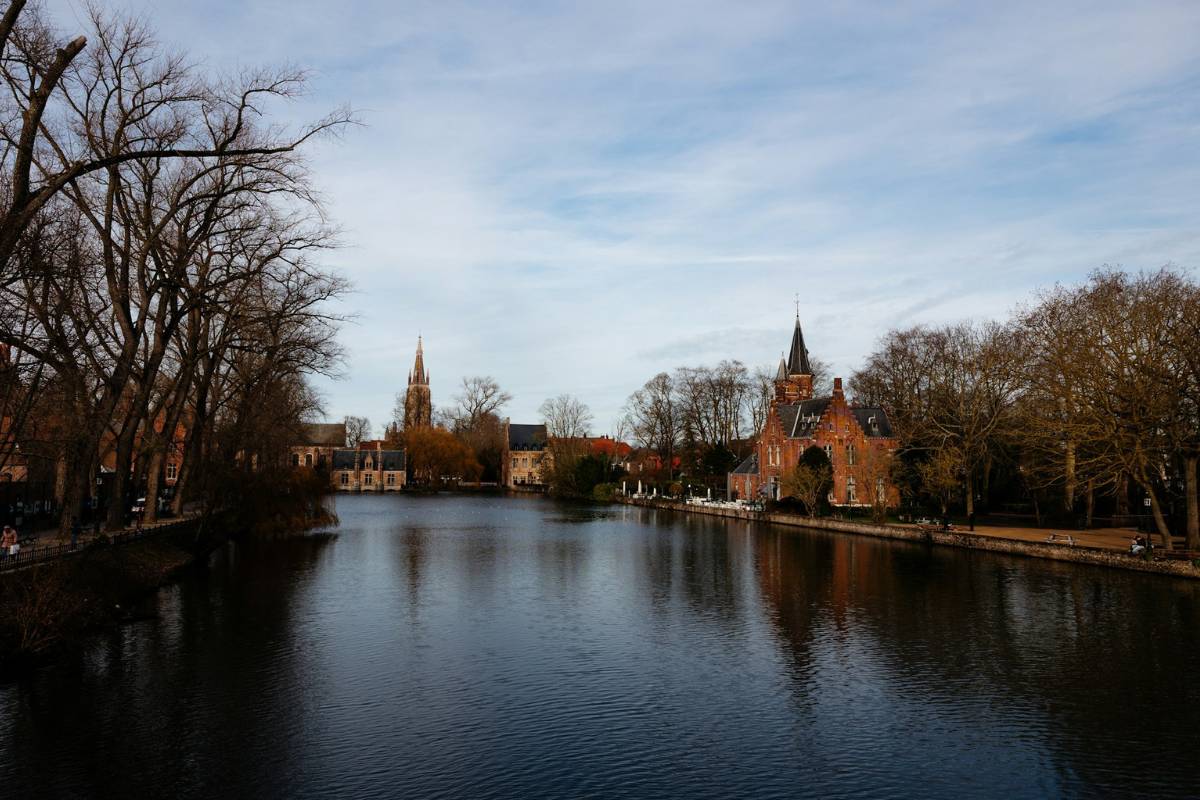
Autumn turns the city golden and quiet. Winter — fog on the canals, the Belfry disappearing into low cloud, the chocolate shops doing their best business — is genuinely the season for it. Spring is soft and uncrowded before the summer rush. Summer is beautiful and very, very busy.
When to Go
Autumn (September–November) is when Bruges is most honestly itself. The summer visitors thin out after early September, the light goes warm and amber, and the streets return to a pace that lets you hear your own footsteps on the cobbles. October is arguably the finest month.
Winter (December–February) is the connoisseur's choice. The Christmas market on the Markt and Simon Stevinplein is lovely — small, genuine, and free of the corporate scale that mars some European Christmas markets. Bruges in January or February, when the tour groups are absent and the fog comes off the canals in the morning, is as atmospheric as the city gets. Restaurants are calmer, hotels are noticeably cheaper, and you will feel, walking the streets before 9am, as though you have the medieval world briefly to yourself.
Spring (March–May) is gentle and increasingly popular. The city greens up, canal boats resume, and the early weeks of the season — before Easter and the school holidays bring the first crowds — are an excellent window.
Summer (June–August) is peak season and should be approached strategically. The city is beautiful in summer light, the canal boat tours are running, and the café terraces are full. But weekend afternoons in July and August can be genuinely overwhelming — the streets around the Markt, the Burg, and the Rozenhoedkaai canal view fill with tour groups and cruise-ship excursions moving in formation. The solution: stay at least one night (day-trippers leave by early evening), explore before 9am and after 6pm, and find your way into the quieter western and southern quarters of the centre.
Getting There
By train from Brussels: About one hour by direct train from Brussels-Midi or Brussels-Central to Bruges station. Frequent departures; no reservation required. One of the best urban train journeys in Belgium.
By train from Ghent: About 25–30 minutes. Bruges and Ghent make a natural two-city pairing for a Belgian trip.
By train from Brussels Airport: Take the Airport Express to Brussels-Midi, then connect to Bruges — total journey around 1.5 hours. Straightforward and inexpensive.
By car from Brussels: Around 1 hour 20 minutes via the E40. However, driving into the historic centre is heavily discouraged and largely restricted. Park at one of the large parking facilities at the railway station or the Bargeplein car park near the ring road and walk or take a bus or bike from there. Driving through the cobbled centre looking for parking is an exercise in frustration.
By Eurostar connection from London: Take the Eurostar to Brussels-Midi (2 hours), then the train to Bruges (1 hour). London to Bruges in around 3.5 hours total — a fully viable weekend trip from the UK without a single airport.
Within the city: Walk, almost entirely. The historic centre is small enough that you can cross it end to end in 25 minutes at a leisurely pace. Bikes are an excellent alternative — Bruges is flat, well-marked for cycling, and bike hire is available throughout the city. Canal boat tours (departing from multiple points along the Dijver) offer 30-minute circuits of the main waterways and are genuinely lovely.
Where to Stay
Bruges is small, and its accommodation is concentrated within and just outside the ring of canals. Staying inside the historic centre — regardless of the specific hotel — puts you within walking distance of everything.
The Markt and Centre for maximum convenience and atmosphere. Hotel Heritage and Martin's Relais are polished boutique choices; The Pand Hotel in a restored carriage house is a quiet favourite. Proximity to the Markt means some noise on weekend evenings — bring earplugs for Friday and Saturday nights in summer.
The Dijver and Canal Quarter for the most beautiful setting — canal-facing rooms in historic houses, often with private gardens. Hotel de Tuileriën and Relais Bourgondisch Cruyce (a 15th-century house directly on the canal) are among the most atmospheric hotels in the city.
Near the Begijnhof and Minnewater in the south of the centre: quieter, slightly removed from the main tourist circuits, and within steps of the loveliest parts of the city. B&B Côté Canal, Hotel Adornes, and several beautifully kept chambres d'hôtes suit this area well.
Outside the ring road for better prices and a more local feel — a 15-minute walk or quick bike ride from the Markt. Many pleasant smaller hotels and B&Bs sit in the residential streets just beyond the moat.
Booking: Weekends in July and August fill months in advance. Weekday and off-season stays are significantly easier to find and considerably cheaper. Bruges has enough good accommodation that booking early is rewarded — the best canal-view rooms go first.
What to See and Do
The Markt and the Belfry
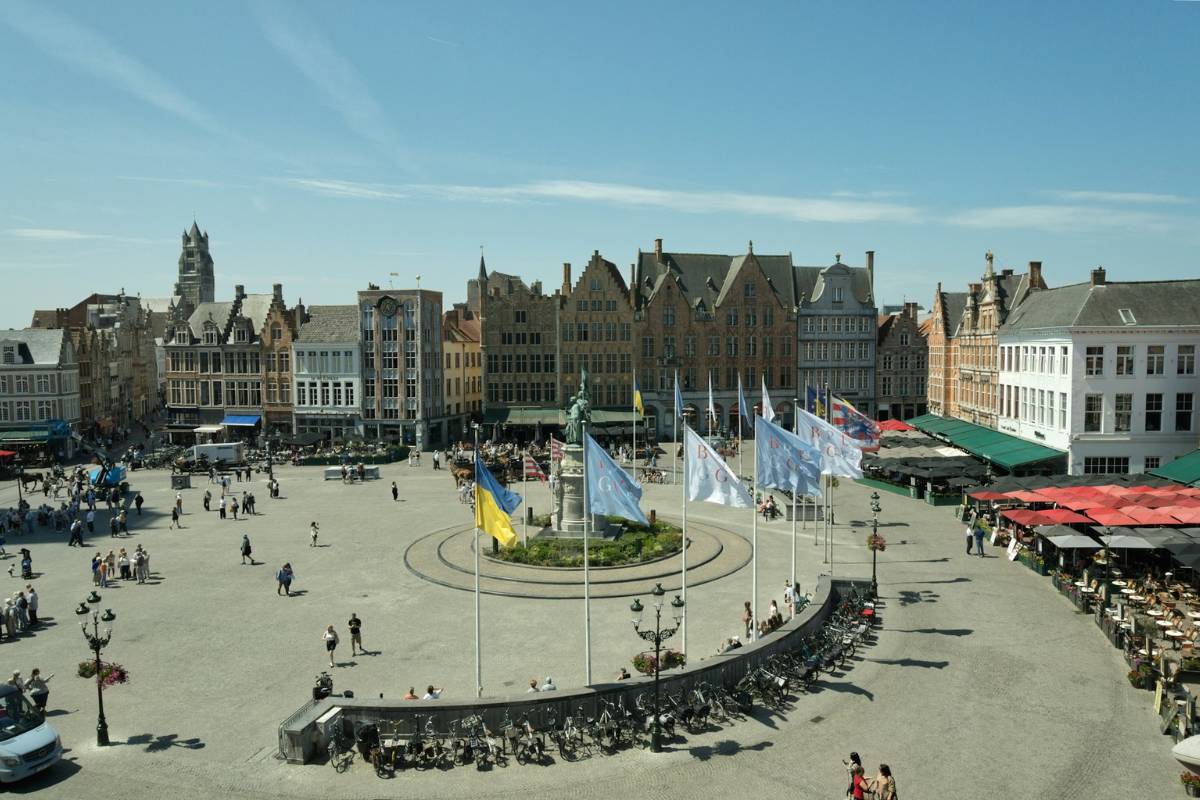
Start here. The Markt is the city's heartbeat — a broad, cobbled square ringed by guild houses and café terraces, with the Belfort (Belfry) rising 83 metres from the southern end, its carillon of 47 bells audible across the city every quarter-hour. Built in the 13th century and added to repeatedly over the following two hundred years, the Belfry is the defining image of Bruges and one of the great medieval towers in Europe.
Climb it: 366 steps in a narrow stone spiral, past the treasury room where the city's charters were kept, past the massive drum mechanism of the carillon, to the top platform and a panorama of the Flemish lowlands stretching flat to every horizon. The view is best in early morning, before the haze builds.
Come back to the Markt in the evening, when the neo-Gothic Provincial Court and the guild houses are lit and the crowds have thinned. This is when the square earns its keep.
The Burg
One minute's walk from the Markt, the smaller Burg square is the city's civic and spiritual centre — and more interesting architecturally, if less photographed. The Gothic Stadhuis (City Hall), dating to 1376, is the oldest in Belgium; its ornate Gothic Hall upstairs is open to visitors. The Renaissance Bruges Franc (Palace of the Liberty of Bruges) faces it, with an extraordinary Renaissance fireplace inside.
Most significantly: the Basilica of the Holy Blood, squeezed into one corner of the square, is a double chapel of which the lower Romanesque level (12th century) and the ornate upper Gothic chapel (15th century) are startlingly different in character. The basilica claims to contain a phial of cloth soaked in Christ's blood, brought to Bruges from Jerusalem in 1150 by the Count of Flanders. On Ascension Day, this relic is carried in procession through the city — the Procession of the Holy Blood, a UNESCO Intangible Heritage event, and one of the great traditional pageants of Belgium.
The Groeningemuseum
Small, uncrowded, and containing one of the great collections of Flemish painting in the world — the Groeningemuseum is the essential Bruges cultural stop, and one that rewards even visitors who don't normally seek out art museums.
The Flemish Primitives gallery includes Jan van Eyck's Madonna with Canon van der Paele (1436), painted with a precision and realism so far ahead of its time that it still stops people cold. Hans Memling, Gerard David, Hugo van der Goes — the founding generation of Northern European painting, most of them working in Bruges. The late 19th and early 20th-century Belgian rooms upstairs round out a collection of real depth.
The Memling Museum at Sint-Janshospitaal
In a 12th-century hospital that operated until 1976 — its wards, dispensary, and chapel intact — the Memling Museum houses six altarpieces and painted works by Hans Memling, the German-born master who worked in Bruges from 1465 until his death in 1494. The Shrine of Saint Ursula, a gilded reliquary painted like a miniature Gothic chapel, is one of the finest small-scale works of the 15th century. The setting — medieval hospital architecture, filtered light, the original furniture preserved in the wards — is extraordinary.
Church of Our Lady and Michelangelo's Madonna
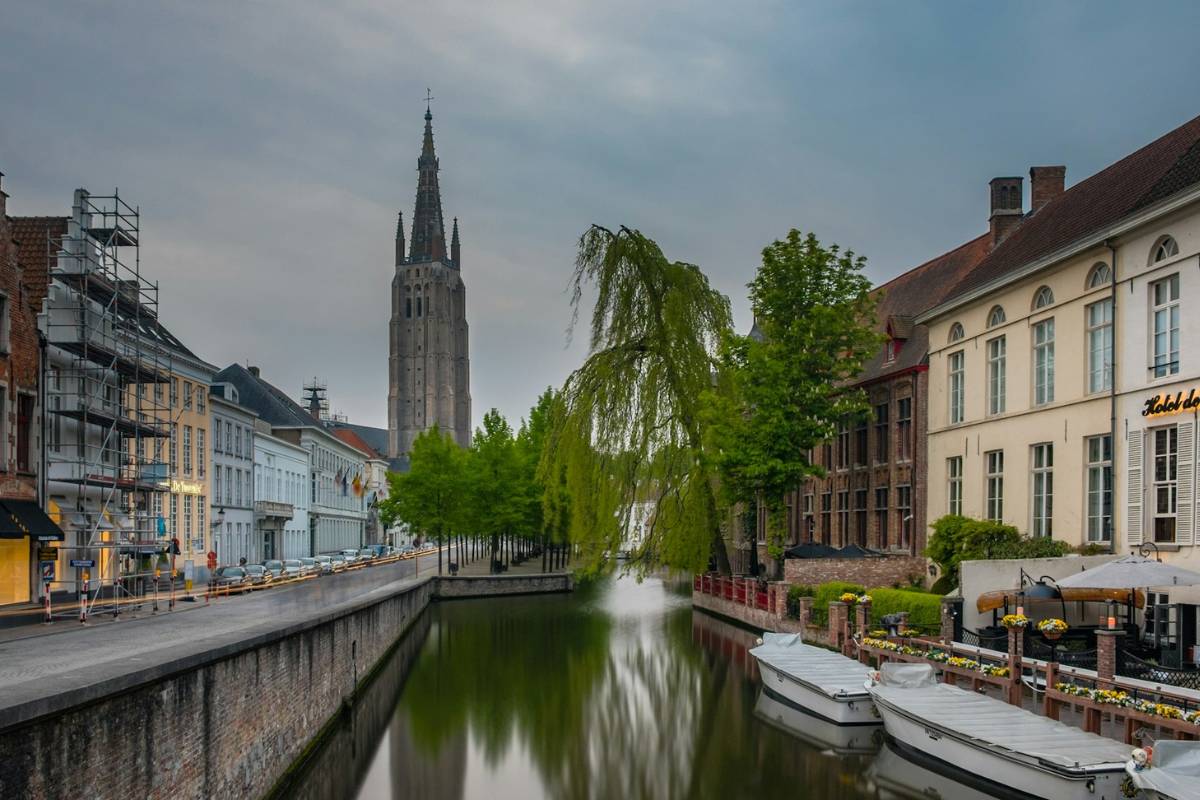 The Onze-Lieve-Vrouwekerk (Church of Our Lady) has a brick tower reaching 115 metres — the second-tallest brick tower in the world — and inside, almost incongruously, a white marble Madonna and Child by Michelangelo. Carved around 1501, when the artist was in his mid-twenties and working simultaneously on the David, it was bought by a Bruges merchant and shipped north — the only work by Michelangelo to leave Italy during his lifetime.
It is, simply, astonishing. Serene and technically perfect, in a side chapel of a Flemish Gothic church on a quiet street in a small Belgian city. Entry to the church is free; a small fee for the art section.
The Begijnhof and Minnewater
South of the Church of Our Lady, the city opens into its two most romantically tranquil spaces.
The Begijnhof is a 13th-century enclosed community originally built for Beguines — lay religious women who lived communally without taking formal vows. The white-walled houses around a central garden, now occupied by Benedictine nuns, are open to visitors who enter quietly and respect the atmosphere. In spring, the central lawn is carpeted in daffodils.
Beyond the Begijnhof gate: the Minnewater, or Lake of Love — a broad, willow-fringed lake where white swans drift and a 15th-century powder tower sits on the bank. The swans, according to local legend, must remain in perpetuity: a punishment imposed by the Habsburg Emperor Maximilian I on the city of Bruges in 1488 after a political imprisonment. The legend is almost certainly embellished. The swans are real and photogenic.
Rozenhoedkaai and the Canal Views
The Rozenhoedkaai — the Quay of the Rosary, where the Dijver canal meets the Groenerei — is the most photographed view in Bruges: the Belfry framed above the water between leaning gabled houses, their reflections broken only by drifting swans. It is very beautiful and very photographed, in that order.
The best of many canal views: go early, before the canal boats start their circuits, when the light is low and the water is still. If you stay overnight, this view at dusk is worth any detour.
The Bonifacius Bridge nearby, a small Neo-Gothic footbridge between the Church of Our Lady and the Arents gardens, is the more intimate alternative — less famous, just as lovely, and rarely crowded.
De Halve Maan Brewery
The only active brewery remaining within the Bruges city walls, De Halve Maan (The Half Moon) has been making beer here since 1864. Its flagship beers — Brugse Zot (a golden ale) and Straffe Hendrik (a stronger Tripel and Quadrupel) — are among the finest Flemish ales produced anywhere.
The guided brewery tour (45 minutes, multiple languages, ends with a beer) is excellent and informative. The rooftop terrace offers a fine panorama of the city.
Most remarkably: in 2016, after years of planning, De Halve Maan completed a 3.2-kilometre underground beer pipeline connecting the brewery in the city centre to its bottling facility outside the historic area — running beneath the medieval streets and canals to avoid disrupting them with tanker trucks. It is the most Belgian solution to a logistical problem imaginable.
The Dijver Antique Market
On weekends from spring through autumn, the Dijver canal bank hosts an outdoor antique and flea market — prints, lace, coins, old maps, Delftware, and general Flemish miscellany. Unhurried browsing on a canal bank on a Saturday morning, with the Belfry above you and a coffee in hand, is approximately the ideal Bruges morning.
The Windmills
On the northeastern edge of the historic centre, where the ring canal meets the old ramparts, four windmills stand on the grassy earthworks above the moat. Two are working mills open for visits in summer. The walk along the ramparts between them, with views over the canal and the patchwork of gardens below, is one of the city's quietest pleasures — and almost entirely missed by visitors who don't cross the ring road.
Where to Eat and Drink
Bruges has been improving its restaurant scene for a decade and is now genuinely excellent, though the streets closest to the Markt still contain their share of tourist-trap menus. The rule holds: the further from the Markt, the better the food.
Flemish stew (stoverij): Beef slow-braised in Belgian ale, served with frites. The definitive Flemish dish. Den Dyver serves it with exceptional beer pairings in a candlelit townhouse. Bistro de Pompe in the quieter western quarter does a reliable version at honest prices.
Moules-frites: Mussels from the North Sea, steamed with celery and white wine, with a cone of frites on the side. Available everywhere; better at De Visserie or along the Vismarkt (fish market) than in the restaurants facing the Markt directly.
Frites: Get them from a proper friture stand — Frituur 't Stationsplein near the station or Diksmuids Boterhuis for the crispest, most correctly cooked Belgian frites in town. Mayo, always.
Fine dining: Zeno for modern Flemish cooking at its most precise. Rock Fort is a relaxed bistro that produces exceptional food without ceremony. Gruuthuse Mes — in a 15th-century palace overlooking the Church of Our Lady — has perhaps the finest setting for a meal in the city.
Beer: At De Halve Maan itself for the brewery experience. 't Brugs Beertje on Kemelstraat for one of the great specialist beer cafés of Belgium — 300+ beers, serious knowledge behind the bar, the warm compaction of a room that has been doing this since 1983. De Garre, down an unmarked alley off the Breidelstraat, serves only its own house Tripel at 11.5% — a single, exceptional beer in a room you'll stay in longer than intended.
Chocolate: Bruges has more chocolate shops per square metre than almost any city on earth, ranging from excellent to tourist-trap. The Chocolate Line by Dominique Persoone is the most inventive — wasabi ganache, Cuban cigar-infused pralines, bacon chocolate. Dumon is a family chocolatier making everything by hand in a small shop near the Markt. Depla in the Steenstraat for truffles without the tourist premium.
Waffles: Chez Albert and Malesherbes for a proper Brussels waffle. The Liège waffle from a street stall, hot from the iron — there are good ones near the Burg and on the Steenstraat.
Coffee: Blackbird Coffee & Vintage Goods, Books & Brunch (also excellent for a slow morning), and Café Vlissinghe — founded in 1515, the oldest café in Belgium still operating as a café, with a bocce court in the garden.
Practical Tips
Come on a weekday. This is the single most impactful piece of advice for a summer visit. The volume difference between a Saturday in July and a Tuesday in July is startling. If your schedule allows any flexibility, use it here.
Stay at least one night. Bruges is most often visited as a day trip from Brussels, and while that's understandable, the city after 6pm — when the day-trippers have returned to the trains and the streets empty out — is a different and considerably better experience. Morning light on the canals, empty cobblestones, your own leisurely breakfast: these require a bed in the city.
Climb the Belfry early. The queue builds through the morning and can be 45 minutes-plus by 11am on summer weekends. Go first thing, when it opens at 9:30am.
Book canal boats vs. walk the banks. The 30-minute canal boat tours are popular and genuinely pleasant. You can also simply walk the canal banks — the Groenerei and Langerei in particular — for equivalent views at your own pace, for free.
The "In Bruges" question: The 2008 film directed by Martin McDonagh, starring Colin Farrell and Brendan Gleeson as two hitmen hiding in the city, is worth watching before you arrive — partly because it's an excellent film, and partly because the locations (Markt, Belfry, Burg, canal bridges, Minnewater) are used beautifully and will mean something when you're standing in them.
Lace: Bruges has a centuries-old tradition of handmade bobbin lace. Genuine handmade Bruges lace is rare and expensive; most of the lace sold in tourist shops is machine-made and imported. Kantcentrum (Lace Centre) on Peperstraat demonstrates the real craft with live demonstrations on weekday afternoons.
Bruges swans: The white mute swans on the canals and Minnewater are a municipal institution, protected by city ordinance. They are also excellent at ignoring tourists with cameras and continuing about their business.
Wear comfortable shoes. The cobblestones are original, uneven, and beautiful — and will have made their point by day two. Heels are not advisable.
Cycling: The city is extremely flat and well-marked for bikes. A half-day cycling circuit of the outer ring — ramparts, windmills, polder countryside beyond the moat — is a genuine pleasure and almost entirely unvisited by tourists on the main walking circuits.
How Long Do You Need?
A day trip: Viable from Brussels or Ghent, and the most common way people visit. You'll see the Markt, Belfry, Burg, a canal view or two, and eat something excellent. You'll also leave knowing you've only seen the surface.
One night / two days: The right amount for a first proper visit. Day one for the main sights and the Groeningemuseum. Evening walk after the crowds leave. Day two for the Begijnhof, Minnewater, Memling Museum, Michelangelo, the brewery, and a long unhurried lunch.
Three to four days: Now you can really settle in. Morning walks before the city wakes, afternoon hours in the quieter western and northern quarters, cycling the ramparts, finding your own favourite café and returning to it. Bruges rewards slowing down more than almost any city its size.
A week: You'll feel like a temporary resident. Combine with a day trip to Ghent (25 minutes by train) for a city that many visitors prefer for its livelier, less purely touristic energy. Add a cycling day into the Flemish countryside — the polders north and west of Bruges, flat as a table, are magnificent on a bike in good weather.
There is no such thing as enough time in Bruges.
Final Thoughts
Bruges is a city with an unusual relationship to time. It was frozen, more or less, at the end of the 15th century — preserved by accident, by the retreat of a river, by the modest indifference of subsequent centuries — and then rediscovered in the 19th and exported to the world in the 20th. It knows what it is. It has leaned into it completely, and the result is sometimes overwhelming and always, when the light is right and the hour is early and the canals are still, genuinely beautiful.
The tension is real. Bruges in high summer can feel like a city performing itself for an audience, and that performance can be exhausting. But underneath it — before the first canal boats, after the last tour group, in November when the mist sits low on the water — is a city of extraordinary quietness and age.
It has Jan van Eyck's paintings and Michelangelo's marble and a brewery that ran a pipeline under the medieval streets because it loved them too much to put trucks on them. It has a 500-year-old café and a tradition of lacemaking that takes years to learn. It has the sound of 47 carillon bells marking the quarter-hours across rooftops that have been there since the guilds built them.
People who visit once tend to come back. People who come back come in autumn or winter for the quiet version. People who keep coming back eventually find themselves in the Memling Museum on a grey Tuesday morning, alone with a 15th-century altarpiece, completely at peace with where they are.
It will still manage to surprise you. Every single time.
Pack comfortable shoes. Come on a weekday. Stay for the evening.
The canals are waiting.


