Brussels: The Complete Travel Guide to Europe's Most Underestimated Capital
June 10, 2026 · TripOnly

Brussels: The Complete Travel Guide to Europe's Most Underestimated Capital
There are cities that wear their greatness loudly. And then there are cities that wait — that reward the traveller who slows down, turns off the main boulevard, finds the neighbourhood behind the neighbourhood, and eventually realises, usually around the second or third day, that this city has been excellent all along and they nearly missed it.
Brussels is that city.
The capital of Belgium and the de facto capital of the European Union occupies a particular and peculiar place in the European imagination. It is famous, largely, for things that happen to be located here — the EU institutions, NATO headquarters, the Grand Place, the bewilderingly famous small statue of a urinating child — and rather undervalued for what it actually is: a deeply cultured, extraordinarily food-obsessed, Art Nouveau–saturated, comic-strip-mural-lined, multilingual city of two million people that happens to contain some of the finest chocolate, beer, and French fries in the world.
It is also a city of tensions and contradictions that make it fascinatingly alive. French and Dutch share official status, though French dominates in the streets. Bureaucratic and bohemian neighbourhoods sit in each other's pockets. Grand imperial architecture rises a short tram ride from some of the most inventive street food in Northern Europe. The European Quarter — all glass and lobbying — dissolves into the flea markets and antique dealers of the Sablon without transition.
Whether you're tracing Art Nouveau façades in Saint-Gilles, drinking gueuze in a century-old estaminet, standing in a Grand Place glowing gold in the evening light, or eating the definitive cone of frites at Maison Antoine — Brussels delivers on every visit, at every pace, and consistently surprises the travellers who gave it a chance.
People come for a weekend en route to Bruges. They extend the booking. They come back without anywhere else on the itinerary.
This is everything you need to know.
Why Brussels?
 There's a reason Brussels rewards visitors who arrive without inflated expectations and leave with inflated plans to return.
The city is built across a gentle valley — the Lower Town clustered around the Grand Place and the medieval street grid, the Upper Town rising steeply to the palaces, museums, and formal parks of the Sablon and Mont des Arts. Between them, covered shopping galleries (galeries) built in the 19th century shelter boutiques, bookshops, and cafés from the perpetually unreliable Belgian sky.
But Brussels is ultimately a city of neighbourhoods, and the neighbourhoods are where it breathes. The Châtelain area in Ixelles for Wednesday market mornings and excellent restaurants. Saint-Gilles for Art Nouveau streets and a Moroccan-Belgian-Portuguese cultural mix that produces some of the city's best cooking. Matonge, Brussels' vibrant Congolese and Central African quarter, alive with music, fabrics, and braiding salons. The Sablon for chocolate shops and antique dealers. Etterbeek and the EU bubble. The canal district for a changing, gentrifying city of galleries and weekend markets.
Spring brings the blossoming parks and terrace culture returning to life. Summer is mild, lively, and festival-filled. Autumn is excellent — quiet, golden, and easier to navigate. Winter, with the Christmas markets on the Grand Place and the smell of warm waffles and mulled wine in the air, is one of the great cold-weather city experiences in Europe.
When to Go
Spring (April–June) is Brussels at its most agreeable. The café terraces reopen without hesitation (Belgians sit outside in borderline weather out of sheer determination), the parks fill, and the city is comfortable without summer's tourist saturation. The Royal Greenhouses of Laeken open for a brief few weeks in late April and early May — a rare chance to visit the stunning Art Nouveau glasshouses of the royal estate, normally closed to the public.
Summer (July–August) is warm, lively, and packed with outdoor cinema, festivals, and the Brussels Summer Festival. Belgian National Day on July 21 fills the city with celebrations. Accommodation is easier than in many European capitals, and longer evenings reward slow walks through the historic centre.
Autumn (September–October) is excellent for a first visit — the summer crowds thin, the light turns soft and golden, and the city's restaurant and arts calendar hits full stride. BOZAR, the Palais des Beaux-Arts, opens its autumn concert and exhibition season. Museum queues are manageable.
Winter (November–February) is grey, damp, and frequently cold — this is Northern Europe, and the climate doesn't pretend otherwise. The compensation: the Christmas market on the Grand Place and along the Boulevard Anspach in December is one of the most atmospheric in Europe, the café culture is at its cosiest, and hot chocolate in Brussels is, predictably, excellent.
Getting There
By air: Brussels Airport (BRU) at Zaventem, 14 kilometres northeast of the city, handles the majority of international flights. The Airport Express train runs every 15 minutes directly to Brussels-Central, Brussels-Midi, and Brussels-Nord — 17 minutes city centre to airport, around €12. Painless.
Brussels South Charleroi Airport (CRL), used by Ryanair and low-cost carriers, is 60 kilometres south — budget the full hour by dedicated bus to the city centre. Cheaper fares, less convenient; weigh accordingly.
By Eurostar from London: Brussels-Midi in 2 hours from London St Pancras. One of the great European rail connections — city centre to city centre, no airports, and you arrive at a beautiful Beaux-Arts station. Book in advance for the best fares.
By Thalys/Intercity from Paris: 1 hour 22 minutes from Paris-Nord to Brussels-Midi. Absurdly fast. The train is the only rational choice between these two cities.
From Amsterdam: Around 2 hours by direct train. From Cologne: about 2 hours. Brussels sits at the hub of Northern Europe's high-speed rail network — arrivals from anywhere in the continent are unusually civilised.
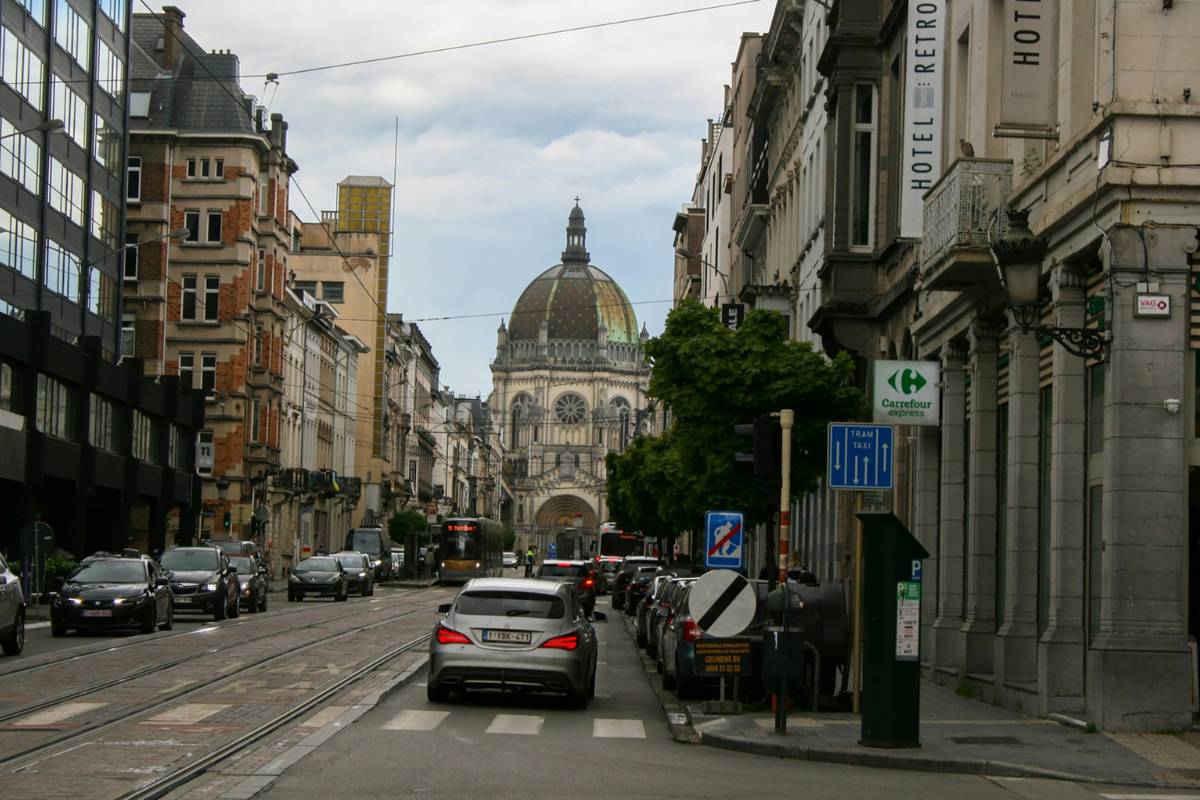
Within the city: The STIB/MIVB runs a network of metro, trams, and buses covering the whole city. The trams are the most pleasant way to move around — slow, scenic, and calming compared to the metro. Buy a MOBIB card or pay by contactless at tram and metro stops. Walking between the Grand Place, the Sablon, Mont des Arts, and Ixelles is highly recommended and fully feasible. The city is hilly — the Upper Town requires either the stairs at the Coudenberg or the free Poelaert lifts from the Marolles flea market. Use them.
Where to Stay
Brussels has the hotel range of a major European capital without its most egregious pricing, and neighbourhood matters considerably.
Grand Place and Ilôt Sacré put you in the tourist heart — minutes from the main sights, very convenient for a first visit, and noisier than you might hope at night. NH Grand Place Arenberg, Amigo Hotel (the classic luxury choice, a street from the Grand Place), and Pillows Grand Boutique Hotel are strong options here.
Sablon and Upper Town for a quieter, more residential feel close to the best chocolate shops, antique markets, and the Royal Museums. Le Louise, Hotel Le Châtelain, and several elegant small boutiques cater to the upscale neighbourhood.
Ixelles and Châtelain for the most local, least touristy experience — amid the Wednesday market, the restaurant strip, and the tree-lined Art Nouveau streets. Excellent Airbnb territory, and a handful of boutique properties.
Saint-Gilles for the budget-to-mid range, a tram ride from the centre, Art Nouveau architecture outside the window, and the most culinarily interesting neighbourhood in the city. Jam Hotel and a cluster of design guesthouses do the area well.
EU Quarter (Etterbeek / Schuman) for proximity to the European Parliament and a quieter, if somewhat characterless, base. Full of functional business hotels at weekday prices that drop dramatically on weekends.
Budget: Brussels has decent hostel options, particularly around the Grand Place and in Ixelles. Week and long-stay apartment rentals are excellent value for stays of four-plus nights.
What to See and Do
The Grand Place
Start here. You have to start here.
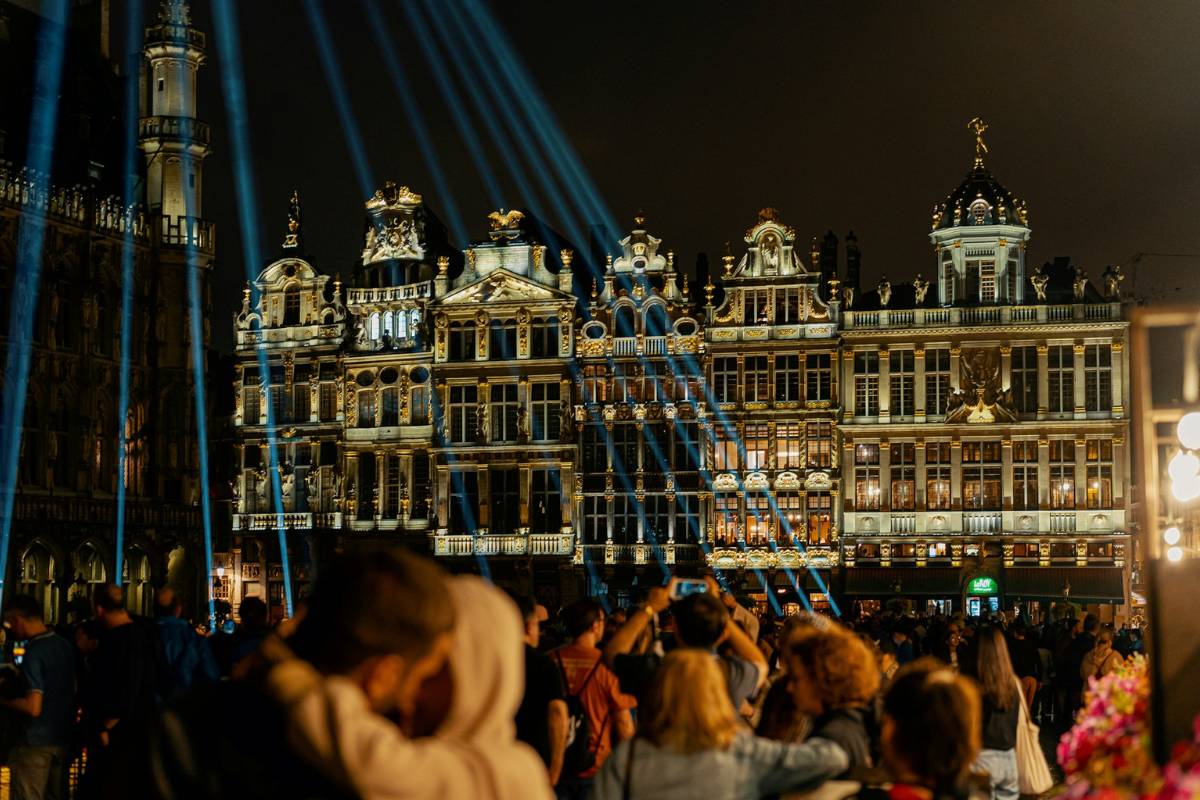
The Grand Place — Grote Markt in Dutch — is, by any honest measure, one of the most beautiful squares in Europe. Victor Hugo called it the most beautiful square in the world in 1852, and while that's a large claim, he had a point. Surrounded by the Gothic Town Hall (its spire alone demands five minutes of uninterrupted staring), the Maison du Roi (now the City Museum), and an arc of lavishly decorated 17th-century guildhalls in Baroque gold and stone, the Grand Place rewards patient, unhurried looking.
The best time: early morning, before 8am, when the light is low and the cleaning crews are finishing and the square belongs almost entirely to you. The second best time: at night, when the whole ensemble is lit from below and turns to amber. The worst time: weekend afternoons in July.
The Grand Place hosts a Flower Carpet in even-numbered years (an enormous mosaic of begonias covering the whole square) and a Christmas market in December that transforms it into something from a northern European fairy tale.
The Horta Museum and Art Nouveau Brussels
This is Brussels' great, underknown treasure.
Victor Horta was a Belgian architect who, in the 1890s, essentially invented Art Nouveau as a built form — sinuous iron structures, organic curves, stained glass flooding rooms with coloured light, and the total abolition of the straight line as a design principle. His own house in Saint-Gilles, now the Musée Horta, is one of the most extraordinary small museums in Europe: every surface, every hinge, every stair rail a work of considered art.
Beyond the museum, Brussels contains the highest concentration of Art Nouveau buildings in the world — most of them in the residential streets of Ixelles, Saint-Gilles, and Etterbeek. The Hôtel Tassel, the Hôtel Solvay, and dozens of private houses are open-air exhibits. Pick up the Art Nouveau walk map from the tourist office and spend a full morning following it.
Musées Royaux des Beaux-Arts and the Magritte Museum
The Royal Museums of Fine Arts on the Rue de la Régence form one of Europe's major art collections — Flemish Primitives, Bruegel the Elder, Rubens, and a collection of 20th-century Belgian work that anchors the adjacent Musée Magritte.
The Magritte Museum is a must. René Magritte — the bowler-hatted, pipe-and-apple painter of surrealist images you've been seeing all your life — was Belgian, lived most of his life in Brussels, and the museum dedicated to his work is the largest in the world. Hats, green apples, windows opening onto paintings of what lies outside: familiar images that remain quietly, persistently unsettling at scale.
Combine both museums and the nearby Musical Instruments Museum (housed in a magnificent Art Nouveau building, with audio guides that play each instrument as you approach it) for a full Upper Town day.
The Belgian Comic Strip Centre
Belgium gave the world Tintin. And the Smurfs. And Lucky Luke, Spirou, Gaston Lagaffe, and a dozen other characters who have collectively sold billions of comics across the globe. The Centre Belge de la Bande Dessinée in a stunning Horta-designed Art Nouveau warehouse in the Centre takes this seriously — and so should you, whether or not you grew up reading the books. The building alone earns the entry price.
Outside: comic strip murals cover dozens of building sides across the city, a permanent, city-scale outdoor gallery walkable as a dedicated half-day route.
Mont des Arts and the Coudenberg Palace
The Mont des Arts terrace, midway between the Lower and Upper Town, offers the finest panorama of the Brussels skyline — the Town Hall spire, the rooftops of the Centre, the arc of the city spreading north. The gardens below are well-kept and pleasant in any season.
Beneath it, accessible from the Coudenberg side: the excavated ruins of the Palais du Coudenberg, the medieval and Renaissance palace of the Dukes of Burgundy and the Habsburg emperors, entombed below street level since the 18th century. A surprisingly atmospheric underground museum for a city with modest obvious archaeological display.
Manneken Pis (and his wardrobe)
Yes, you should see it. No, it is not as big as you expect — at 61 centimetres tall, the famous statue of a small boy relieving himself into a fountain is one of Europe's most reliably anticlimactic sights, and Belgians are aware of this and find it funny.
What's genuinely worth your time: the statue's costume collection in the City Museum on the Grand Place, where over 1,000 outfits donated from around the world — from Elvis to Elvis-Presley-era-footballer to intergalactic spaceman — are displayed with entirely straight-faced archival seriousness.
The Sablon and Its Pleasures
 The Place du Grand Sablon is Brussels' most elegant square — a triangle of café terraces, antique dealers, and some of the finest chocolate shops in a city that takes chocolate with great seriousness.
Wittamer, which has been making cakes and chocolates from the same Sablon address since 1910, is the institution. Pierre Marcolini, a few doors down, is the avant-garde — single-origin, minimal sugar, cacao as flavour rather than just sweetness. Around the corner, Neuhaus, which invented the praline (the filled chocolate) in Brussels in 1912, stakes its own claim.
The Antiques Market on the Grand Sablon functions on weekend mornings — silver, prints, vintage maps, Art Nouveau objects, and the pleasantly aimless browsing that precedes a long lunch.
The Atomium
Built for the 1958 Brussels World's Fair and never taken down — because how do you dismantle something that outrageous — the Atomium is nine stainless-steel spheres connected by tubes, representing an iron crystal magnified 165 billion times, standing 102 metres high in the Laeken district north of the city.
It is completely absurd and completely wonderful. The interior contains exhibition spaces and an observation sphere with a panoramic city view. The surrounding Mini-Europe park (scale models of European landmarks) and the adjacent Palais Royal de Laeken gardens (open a few weeks in spring) make for a full north-Brussels afternoon.
The Marolles Flea Market
Every morning, the Place du Jeu de Balle in the Marolles district — the old working-class neighbourhood below the Palais de Justice — hosts a flea market of genuine, unjuried, unbeautified character. Not the curated antique dealers of the Sablon, but the real thing: boxes of records, orphaned cutlery, obsolete electronics, old photographs, paperback detective novels, and occasionally something extraordinary hidden in a cardboard box.
Take the free Poelaert lift down from the Palais de Justice, arrive before 10am, and bring cash.
Day Trips: Bruges, Ghent, and Waterloo
Brussels is an almost embarrassingly convenient base for Belgian day trips.
Bruges is one hour by direct train — the medieval canal city, gorgeous and popular and worth every superlative, though go on a weekday to avoid the worst of the weekend crowds. Ghent is 30 minutes — arguably better than Bruges, with a comparable medieval centre, a livelier university energy, and a food scene that surpasses both Bruges and Brussels in ambition. Waterloo, 30 minutes south by train and bus, is the battlefield where Napoleon's ambitions ended in June 1815: an excellently presented site with the famous Lion's Mound viewpoint and a serious new visitor centre.
Where to Eat and Drink
Brussels is, quietly and sincerely, one of the great eating cities in Europe. The Michelin star count per capita regularly challenges Paris. The casual cooking — moules, frites, waffles, beer — is as good as anywhere its traditions were invented.
Belgian frites: The best in the world — yes, including anywhere in the Netherlands. Get a cone from Maison Antoine at Place Jourdan (the legendary benchmark, operating since 1948), served with andalouse, samurai, or simply mayonnaise — Belgian mayo, which is richer and better than what you're used to. Eat them standing up. Don't put them in a bag.
Moules-frites: Chez Léon near the Grand Place is the institution (touristy, reliable, vast). La Mer du Nord in the Sainte-Catherine fish market area is the local alternative — a fish stall with a communal standing terrace and some of the freshest shellfish in town.
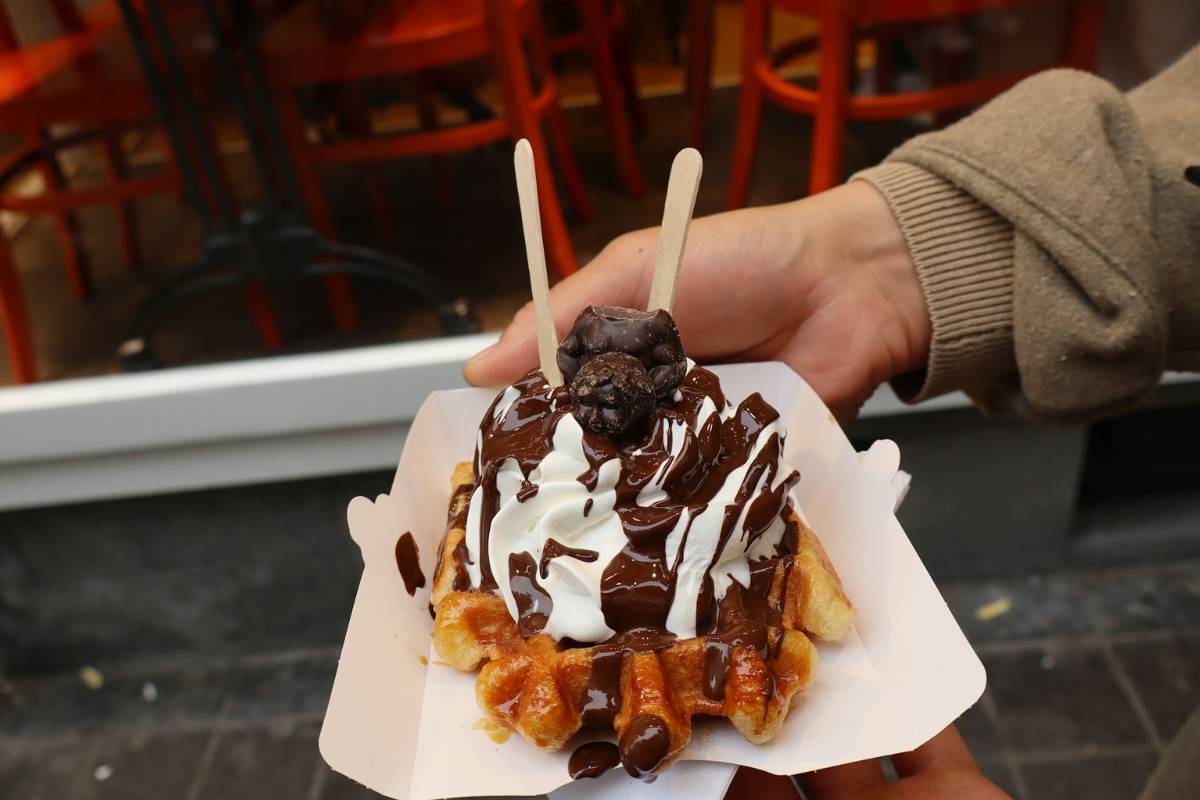
Waffles: Brussels waffles (lighter, rectangular, crisp, eaten with toppings) versus Liège waffles (denser, pearl sugar, eaten plain and warm). Both are correct. Maison Dandoy near the Grand Place does Brussels waffle with authority. The Liège waffle from a street cart, eaten warm from the griddle, needs nothing added.
Estaminets and Belgian beer: À La Mort Subite near the Galeries Royales Saint-Hubert is the classic — gueuze and lambic beers in a 1928-unchanged café with wooden booths and zero irony. Delirium Café near the Grand Place holds a Guinness World Record for its beer list (3,000+) and is exactly as anarchic as it sounds on a Friday night. Moeder Lambic on the Place Fontainas is for serious beer conversation.
Fine dining: Comme Chez Soi — two Michelin stars, an Art Nouveau interior by Horta, and cooking that has defined Belgian haute cuisine for decades. The Jane Brussels, Brasserie de la Paix, and San are newer names in a dining scene that keeps producing serious cooking.
Neighbourhood cooking: Fin de Siècle in the Centre for straightforward, excellent Belgian cooking in a no-reservations room that fills fast. The restaurant strip around Rue du Page in Ixelles for the city's most reliable modern bistros. Châtelain on a Wednesday evening after the market.
Chocolate to take home: Pralines from Neuhaus or Wittamer for the classic; single-origin from Pierre Marcolini or Galler for something more contemporary.
Coffee: OR Coffee, Hoppy Lemon, and Café Costume (in the showroom of a tailoring business, which is very Brussels) are the standards.
Practical Tips
Language: Brussels is officially bilingual — French and Dutch (Flemish). In practice, French is dominant in the city, with Dutch more prominent in Flemish suburbs. English is very widely spoken, especially among younger residents and in the service industry. A bonjour or goeiedag is appreciated; defaulting to English is completely accepted.
The city is hilly. The split between Lower Town (Grand Place, Sainte-Catherine, Marolles) and Upper Town (Sablon, Mont des Arts, museums, Ixelles) is real and the incline is genuine. The free lifts at Poelaert are a public service of some distinction.
Don't underestimate the transit. The tram network, in particular, is excellent and underused by tourists who assume they need to walk or take taxis. Tram 81 (Ixelles, Saint-Gilles) and tram 92 (Sablon, Horta Museum, ULB) are your friends.
Book restaurants ahead. Brussels' best small bistros fill fast, especially Thursday through Saturday. Same-day bookings are often impossible at popular addresses. Plan ahead or arrive early and wait.
The weather is honestly unreliable. Pack a compact umbrella and a light waterproof layer regardless of the season. Brussels has a talent for rain that arrives without particular warning or commitment.
Sunday closings are real. More shops and some smaller restaurants close on Sundays than in most major European cities. The compensations: the Marolles flea market, a quieter Grand Place, and the best excuse in the world for a long café morning with Belgian newspapers and a third coffee.
The EU Quarter is strangely interesting. The Berlaymont building (European Commission), the European Parliament (free guided tours available), and the Résidence Palace media centre are open to visitors with advance booking. For anyone interested in how the EU actually functions — or where it chooses to lunch — the quarter rewards a half-day.
Carry cash for the Marolles market, small friteries, and estaminets. Cards are now widely accepted in Brussels, but cash remains appropriate and sometimes expected in old-school establishments that have been operating since before the euro and see no reason to change.
How Long Do You Need?
A long weekend (3–4 days): The Grand Place, the Horta Museum and an Art Nouveau walk, the Royal Museums with the Magritte, the Sablon, moules-frites and a proper beer café, the Marolles flea market, and a night walk through the centre with a waffle in hand. This covers the essential Brussels and leaves you wanting a longer return.
One week: Add the Atomium and Laeken, a day trip to Ghent or Bruges, deeper neighbourhood time in Ixelles and Saint-Gilles, the Comic Strip Centre, Mont des Arts at sunset, and a meal at one of the city's serious restaurant addresses. This is the right amount for a first visit that goes beyond tourist checkboxes.
Two weeks: A full exploration of the city's neighbourhoods — Matonge, the canal district, Molenbeek's fast-changing food and arts scene, the Cinquantenaire park and its trio of museums, the Royal Africa Museum at Tervuren. Day trips to Ghent, Bruges, Dinant, and Waterloo. Time to sit in the same café twice and feel like a temporary local.
There is no such thing as enough time in Brussels.
Final Thoughts
Brussels is a city that doesn't ask to be loved. It doesn't have the operatic beauty of Paris or the picture-book canals of Bruges or the sky-scraping drama of New York. It has something rarer: depth. The kind that reveals itself slowly, neighbourhood by neighbourhood, conversation by conversation, beer by unhurried beer.
It is also, quietly, one of the most cosmopolitan places on earth — not in the headline-grabbing, skyscraper sense, but in the daily reality of a city where Congolese restaurants sit beside Portuguese bakeries sit beside Turkish pâtisseries sit beside Belgian chocolate shops, and all of it is within a single neighbourhood's walk. The multilingual overheard conversations on the tram. The eurocrat in line behind the Marolles fruit vendor at the Friday market. The Horta staircase behind the unremarkable façade on an ordinary side street.
People who visit once tend to come back. People who come back slow down on the second visit and start noticing the things they missed. People who keep coming back stop explaining to others why Brussels and just bring them directly.
It will still manage to surprise you. Every single time.
Pack an umbrella. Learn to say une bière, s'il vous plaît. Stay longer than you planned.
The city is waiting.


