Nice: The Complete Travel Guide to the City Where the South of France Actually Lives
June 28, 2026 · TripOnly

Nice: The Complete Travel Guide to the City Where the South of France Actually Lives
There is a moment that happens to almost everyone who arrives in Nice for the first time. You come out of the train station — a handsome Belle Époque building that the city treats, correctly, as simply the place where the train stops — and you walk ten minutes south, and then the Promenade des Anglais opens in front of you: four kilometres of seafront boulevard, the Mediterranean impossibly blue beyond it, and a light falling over everything that you have seen in paintings your whole life but assumed was artistic licence.
It is not artistic licence. The light here is real. The Impressionists knew it. The Russian nobility knew it. The British aristocrats who built the promenade itself knew it. Now you know it too.
Nice is the fifth-largest city in France and the capital of the Côte d'Azur — the French Riviera — a stretch of coastline running from Menton at the Italian border to Saint-Tropez in the west that has been drawing visitors for two centuries. But Nice is not a resort. It is a city, with a proper old town, a proper market, proper neighbourhood life in its quartiers, proper food rooted in a cuisine that owes as much to Italy and Liguria as it does to France, and a population of 350,000 people who live here because it is one of the finest places in Europe to live an ordinary life extraordinarily.
The Riviera has glamour elsewhere — Monaco twenty minutes to the east, Cannes forty minutes to the west. Nice has something better. It has character.
This is everything you need to know.
Why Nice?
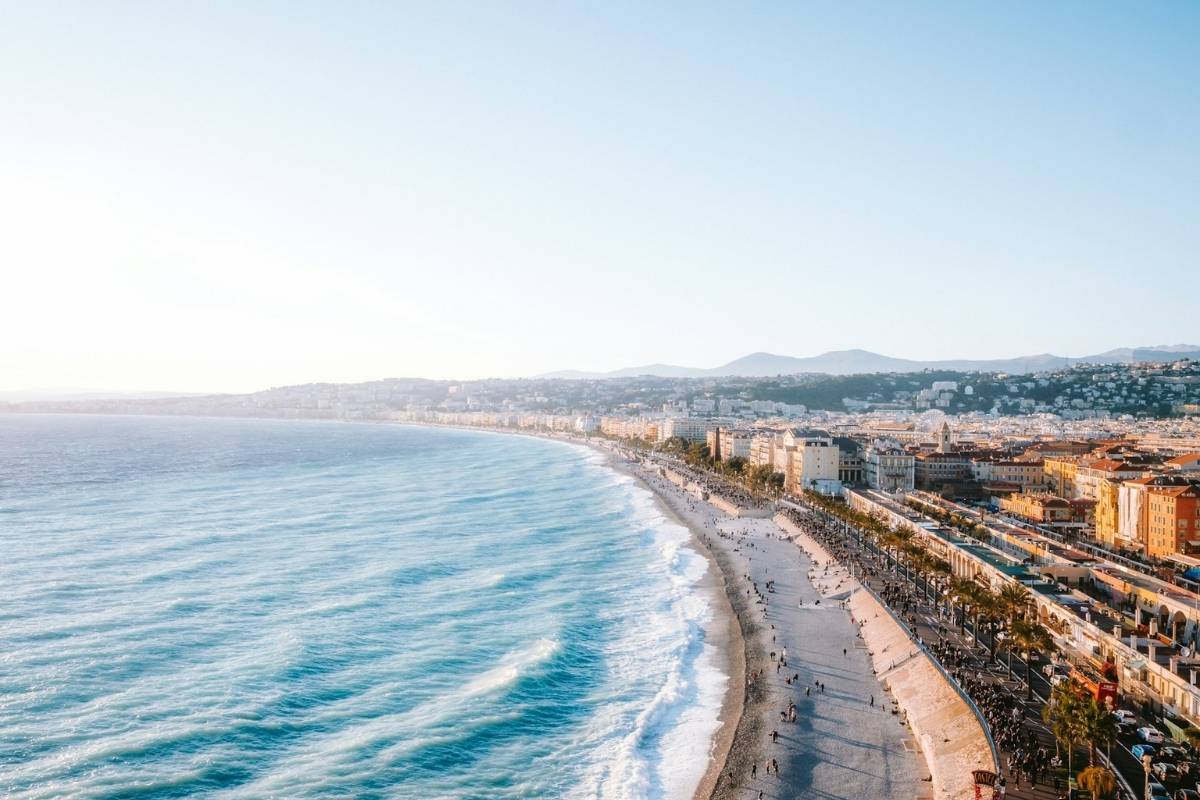
The question is almost unnecessary. Three hundred days of sunshine a year. A medieval old town — the Vieux-Nice — of Baroque churches and amber-painted palaces and a daily market that has been running since before the city was even French. A seafront that manages to be both grand and walkable. An airport that receives direct flights from most of Europe. A cuisine — la cuisine niçoise — built around olive oil, anchovies, chickpeas, zucchini flowers, fresh pasta, and the best tomatoes available, producing a table that is more generous and more interesting than anywhere else in France.
Behind the city, the Alps rise sharply. Thirty minutes inland and you are in hill villages that predate the Republic by several centuries. Forty minutes and you are in genuinely alpine terrain. An hour and you are skiing. Nice sits at the hinge point between sea and mountain, which gives it a geographic position unlike almost any other city in southern Europe — and a climate, protected from northern winds by the mountains while open to the Mediterranean sun, that is as close to perfect as European weather gets.
It also has the Matisse Museum. And the Chagall Museum. And a castle hill with the best view of the bay. And a market every morning. And an old town to get properly lost in.
Nice does not need to try very hard. It has the cards and it knows it. The city's achievement is that despite all of this, it never feels smug.
When to Go
Spring (April–June) is when Nice is at its most balanced — the sea warming, the mimosa and bougainvillea in flower, the promenade filling but not overflowing, the light already at its extraordinary best. May is the ideal month: school holidays haven't broken, the Cannes Film Festival (mid-May) fills the neighbouring city but gives Nice an atmospheric charge without the overcrowding. June is still excellent before the summer peak sets in.
Summer (July–August) is high season in the fullest sense — the beaches fill, the promenade is perpetually busy, and the restaurants on the waterfront charge accordingly. That said, Nice handles its summer better than most Riviera towns: it is a real city with real infrastructure, the old town stays animated, and the evening energy on the Cours Saleya is something you should experience at least once. Book accommodation and restaurants well ahead and accept the season for what it is.
Autumn (September–October) is the quieter prize. The sea remains warm enough to swim — often well into October — the crowds thin sharply after the first week of September, and the light shifts to something richer and more golden. Restaurants return to form after the summer rush. This is the connoisseur's season, and it is significantly underappreciated.
Winter (November–March) is mild by French standards — rarely below 10°C, often much warmer — and increasingly well-regarded by those who know it. Nice is a city that functions fully year-round; the market runs daily regardless, the Vieux-Nice retains its life, and the hotel rates drop significantly. The carnival in February is one of the great European winter festivals. January and February, if you can take the quiet, offer the city at its most authentically its own.
Getting There
By air: Nice Côte d'Azur Airport (NCE) is the third-busiest airport in France, 7 kilometres west of the city centre with direct connections from most major European hubs. The Tram Line 2 (T2) connects the airport directly to the city centre and the main train station in around 30 minutes for €1.70 — the most straightforward airport-to-city connection in France. Taxis run approximately €30–40 to central Nice.
By TGV from Paris: Around 5.5 hours from Paris Gare de Lyon on the direct TGV, with a scenic final stretch along the coast from Marseille. An overnight train service also operates on select days. If you have time, the train is the finest way to arrive — the coast reveals itself gradually as you approach, and the arrival into Nice-Ville station is considerably more romantic than any airport experience available.
By train along the Riviera: Nice-Ville station sits at the centre of the Riviera rail network. Monaco is 20 minutes east. Menton, on the Italian border, is 35 minutes. Antibes is 30 minutes west. Cannes is 40 minutes. Marseille is 2.5 hours. The regional TER trains run frequently and cheaply along the coast — this is the correct way to day-trip.
The Ligne d'Azur network within Nice: The city's tram and bus system is efficient and inexpensive. Tram Line 1 runs east–west across the city; Tram Line 2 connects the port, city centre, and airport. A single ticket costs €1.70; a day pass is available. The Vieux-Nice, the promenade, and the main market are all walkable from each other — Nice rewards pedestrians in the same way the best Mediterranean cities always do.
Where to Stay
Nice divides neatly into a handful of distinct areas, and where you stay shapes the experience considerably.
Vieux-Nice (Old Town): The most atmospheric base, particularly for a first visit. Narrow lanes, Baroque facades in ochre and terracotta, the Cours Saleya market on your doorstep every morning, and the sea five minutes on foot. Boutique hotels and apartment rentals dominate here. Slightly noisy on summer evenings as the terraces fill; this is a feature, not a flaw.
Promenade des Anglais / City Centre: For the classic Nice experience — waking up and walking the seafront before breakfast — the hotels along or near the promenade deliver exactly what they promise. The iconic Hôtel Negresco is the grande dame of the strip, a 1912 palace hotel in pink and white with a Belle Époque dome that has become part of the city skyline. There are more affordable options a block or two inland that still offer easy access to the seafront.
Cimiez: The residential hill district north of the city centre, quieter and more local in character, where both the Matisse and Chagall museums are located. A calm base if you prefer to be away from the coastal energy; the Tram Line 1 connects it readily to the centre.
The Port (Port Lympia): East of the old town, the harbour area has grown into one of Nice's more interesting neighbourhoods — restaurants, fish stalls, the ferry terminal for Corsica, and a Baroque church overlooking the water. Less central but increasingly worth considering.
What to budget: Nice is not cheap, particularly in summer. Expect €100–180 per night for a decent mid-range hotel in spring or autumn; summer rates in good locations run €180–300. The old town apartment rental market can offer better value and a more local experience for stays of three nights or more.
What to See and Do
The Vieux-Nice
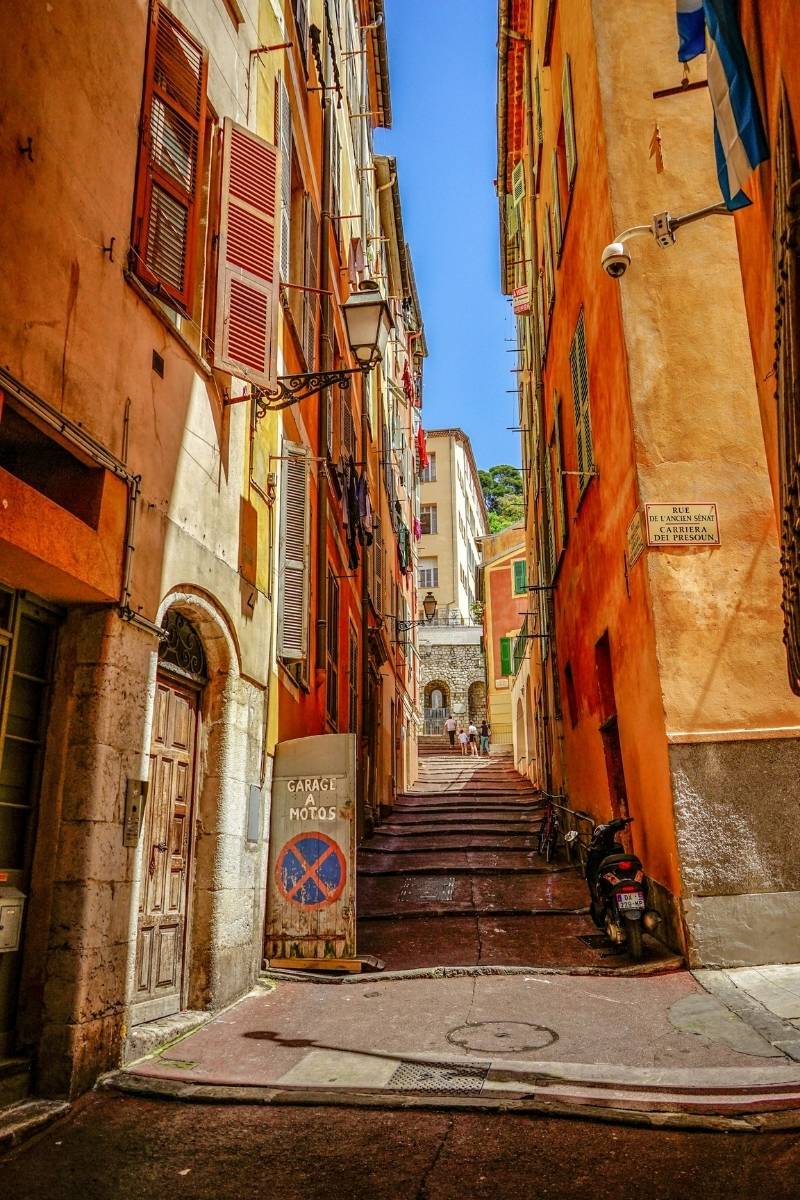
The old town is a medieval Baroque labyrinth in miniature — roughly a kilometre square, bounded by the castle hill to the east, the Cours Saleya to the south, and the modern city to the west. Its character is Italian as much as French: the buildings are painted in the deep pinks and yellows and burnt oranges of Liguria, the socca sellers shout in the Niçard dialect, and the Baroque churches (Cathédrale Sainte-Réparate, the Chapelle de la Miséricorde, Saint-Jacques le Majeur) belong to the exuberant Mediterranean Catholic tradition rather than the restrained Gothic north.
Wander without purpose. Get lost. Emerge at the Cours Saleya and do it again from a different entrance.
Cours Saleya Market
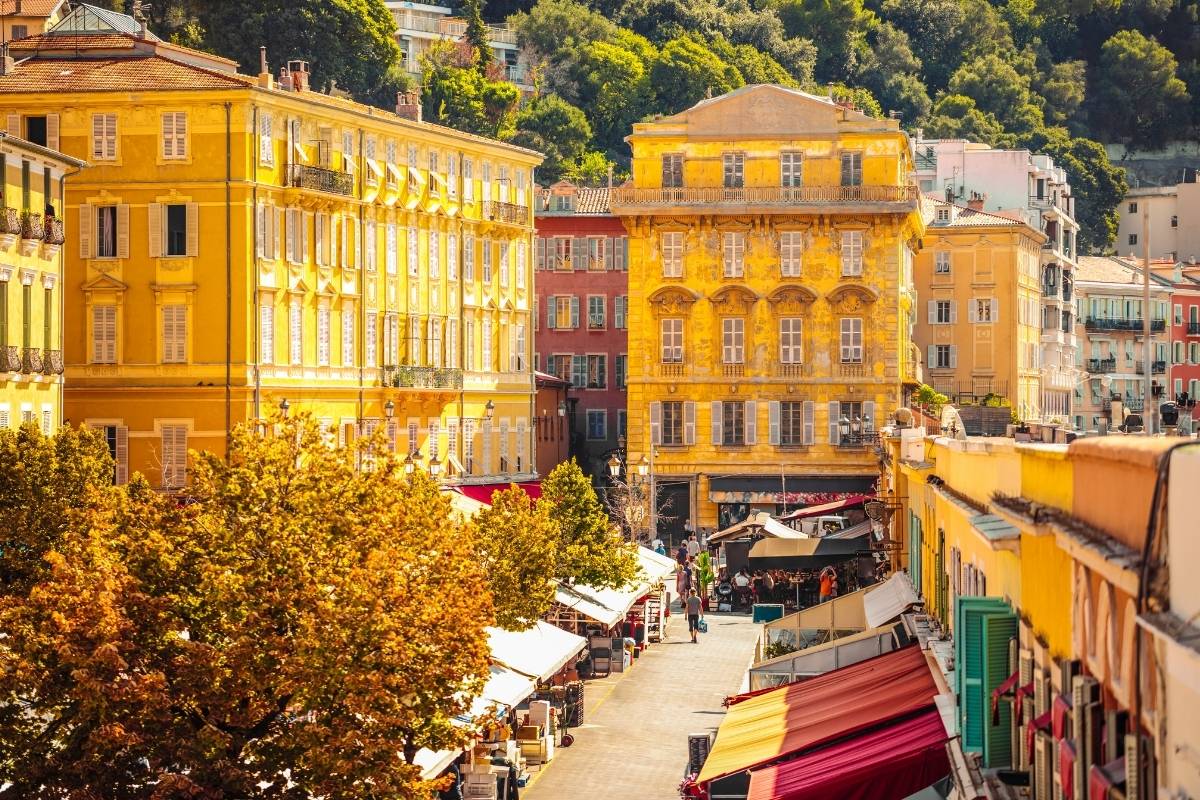
The daily morning market on the Cours Saleya — flowers Tuesday through Sunday, antiques and brocante on Monday — is one of the great market experiences in France and rivals the best in Europe. Vendors have been selling here for centuries; the energy in the morning hours, before the tourists arrive in numbers, is as good as any outdoor market gets. Arrive at 8am. Buy flowers. Buy tomatoes. Buy olives. Sit at one of the terrace cafés with a café au lait and watch the square come to life.
The Castle Hill (Colline du Château)
The hill at the eastern end of the Promenade des Anglais — site of the original medieval fortress, long since demolished — is now a park with the best view in the city. The entire sweep of the Baie des Anges opens before you, the old town rooftops below, the sea beyond in every shade of blue the Mediterranean is capable of producing. Reach it via the free lift at the eastern end of the promenade, or climb the steps from the Vieux-Nice — 15 minutes that earn the view considerably.
The Promenade des Anglais
Four kilometres of seafront boulevard, pebble beaches, and an uninterrupted view of the bay. Walk it in the morning when the joggers and cyclists and sea swimmers are out and the light is horizontal and golden. Walk it again at dusk. The pebble beach experience — Niçois rather than sandy, which surprised many visitors and converted most of them — is particular and pleasurable. Rent a sun lounger, pay for the private beach section, or bring a towel and join the locals on the public stretch. The water is clear, the temperature from June onwards is generous, and there is no better way to understand what makes this city special than lying on these stones watching the waves come in.
Matisse Museum (Musée Matisse)
Henri Matisse lived in Nice for most of the last thirty-seven years of his life, drawn by the light — the same light that caught everyone — and produced here some of the most significant work of his career. The museum, housed in a beautiful 17th-century Genoese villa in Cimiez, holds one of the world's largest Matisse collections: paintings, sculptures, drawings, prints, and the magnificent late paper cut-outs. One of France's great smaller museums, genuinely moving, and always less crowded than it deserves to be.
Chagall Museum (Musée National Marc Chagall)
A ten-minute walk from the Matisse Museum, the Chagall Museum was designed specifically to house seventeen large canvases from Chagall's Biblical Message series — completed in Vence, near Nice — along with mosaics, sculptures, and stained glass. The building is luminous, the collection is extraordinary, and the garden outside is a peaceful place to sit with the Côte d'Azur light falling through the trees. Do not skip this.
Day Trips
The Riviera rail line makes day-tripping effortless. Monaco (20 min) for the Formula One circuit, the casino, and the oceanographic museum. Èze (30 min by bus from Nice) for the perched medieval village and one of the most dramatic views on the French Riviera. Antibes (30 min by train) for the old town, the Picasso Museum in the Grimaldi Castle, and the covered market. Cannes (40 min) for the Croisette, the old harbour, and the Lérins Islands by ferry. Menton (35 min by train) for the most Italian of all Riviera towns, famous lemons, and Jean Cocteau's remarkable museum in the old harbour fortification.
Where to Eat and Drink
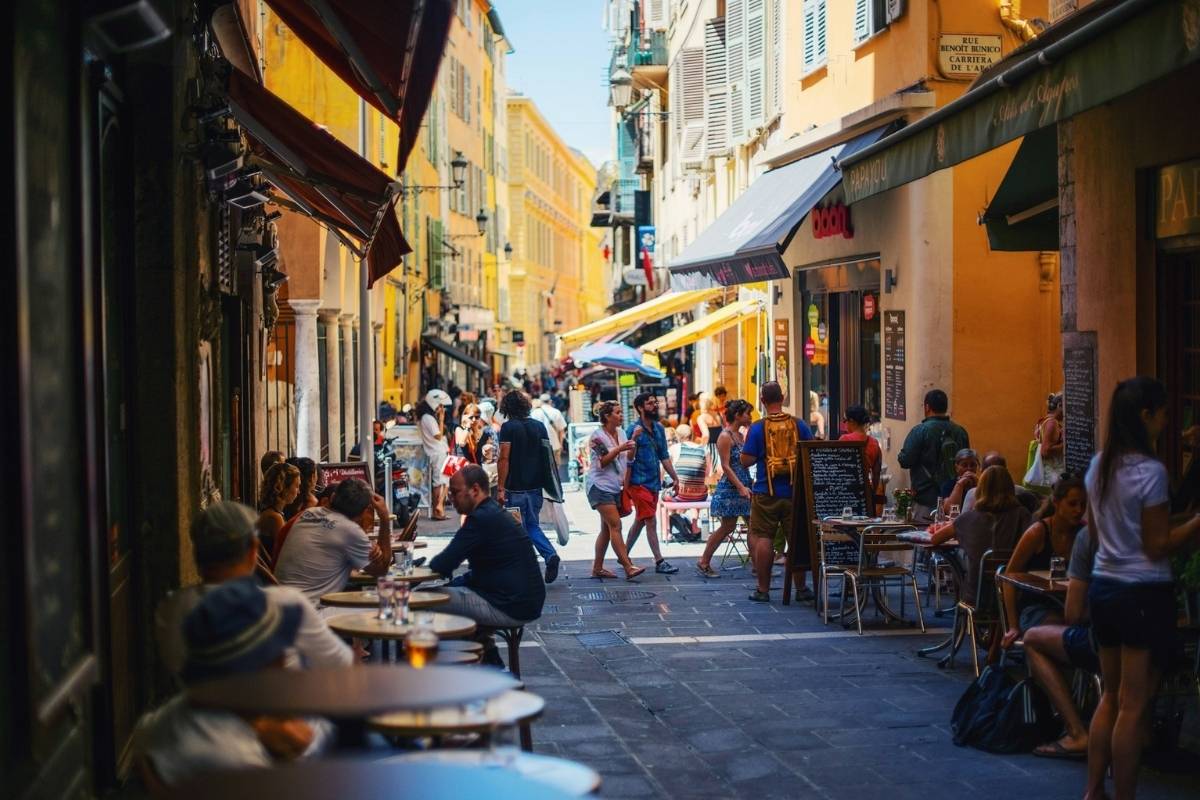
Niçois cuisine is one of France's most distinctive regional traditions — shaped by centuries of proximity to Italy, by Mediterranean ingredients at their freshest, and by a coastal culture that has always known how to eat well without unnecessary ceremony.
Socca: The essential starting point. A thick pancake made from chickpea flour, olive oil, water, and salt, cooked in a wood-fired oven in enormous round pans and served hot in irregular chunks with black pepper. The best socca in the city comes from Chez Thérésa at the Cours Saleya market (mornings only, Tuesday–Sunday) and from the stalls inside the old town's covered part of the Rue Pairolière. Eat it standing up with a glass of rosé. There is no better €3 in France.
Salade Niçoise: Not what most restaurants outside France serve under that name. The original — the canonical version that Niçois will defend aggressively — contains tuna (tinned, in olive oil), hard-boiled eggs, anchovy fillets, raw green pepper, tomatoes, black olives, radishes, spring onions, and basil. No potatoes. No green beans. No cooked vegetables of any kind. The niçoise is a raw salad with preserved fish, and it is better than the corrupted international version in every way.
Pan bagnat: A salade niçoise, compressed between two halves of a round pain de campagne loaf, drenched in olive oil, and left to rest until the bread absorbs everything. The portable expression of the same flavours. Buy one from the market, take it up the castle hill, eat it with the bay in front of you.
Pissaladière: Nice's answer to pizza — a thick bread base topped with slow-cooked onions, black olives, and anchovy fillets. The sweetness of the onions against the salt of the fish is elemental and deeply good. Available from boulangeries and market stalls throughout the old town.
Fresh pasta: The Italian influence runs deep, and the old town has proper pasta shops selling hand-rolled raviolis stuffed with daube (braised beef), tourte de blettes (Swiss chard and raisin tart, sweet and savoury simultaneously), and fresh gnocchi. Buy them to take home or seek out the family-run restaurants in the Vieux-Nice serving them.
Restaurants: La Merenda on Rue Raoul Bosio — tiny, no telephone reservations (you must book in person), no credit cards, and food as good as anywhere in the city. Chez Palmyre for generous traditional Niçois cooking in a room that hasn't changed in forty years. Le Séjour Café for a quieter, more contemporary interpretation of local ingredients. For fish and seafood, the restaurants around the Port Lympia consistently outperform those on the touristy seafront in both quality and value.
Rosé: The Côte de Provence is one of the world's great rosé-producing regions. Drink it here. Order the local label. Sit on a terrace. This is not complicated advice, but it is correct.
Markets: Beyond the Cours Saleya, the Marché de la Libération in the north of the city is the local's market — less photographed, more seriously attended to, and worth the tram ride north for a sense of where actual Nice does its shopping.
Practical Tips
Learn the courtesies. The same rules as all of France: bonjour when you enter anywhere, au revoir when you leave, s'il vous plaît at every ordering moment. Nice has a gentler reputation than Paris and the warmth of the South — but basic courtesy still lubricates everything.
The light is everything. The Côte d'Azur light is not a myth. It is Mediterranean light — the refraction off the sea, the clarity of the air, the angle of the sun at this latitude — and it is the reason this coast has been painted obsessively for 150 years. Plan to be outdoors in the morning and late afternoon. The hours between 11am and 3pm in summer can be harsh; the rest is extraordinary.
Swim in the morning. The public beaches are less crowded before 10am, the water is at its clearest, and the light on the bay at 8am on a clear summer morning is enough to make you rearrange your life around it.
Carry cash in the old town. Many of the market stalls and smaller restaurants — including La Merenda, which will take nothing else — operate cash-only. The ATMs on Rue de France and near the train station are reliable.
Take the train, not the car. The Riviera's coastal A8 motorway is expensive (tolls add up) and heavy with traffic in summer. The regional TER trains along the coast are cheap, frequent, and more pleasant in almost every way. For the Riviera day trips, the train is definitively the right choice.
Book La Merenda in person. Show up and write your name in the book for the evening sitting. This is not an inconvenience — it is an act of faith that the restaurant will repay fully.
The castle hill at sunset. Do this on your first evening. Walk up the steps from the old town, find a bench with a view west over the bay, and watch the sun go down over the Promenade des Anglais and the mountains behind. Every subsequent decision you make in Nice will be made in the knowledge of that view.
Nice is a base, not just a destination. The city is at its best when you treat it as a hub for exploring the Riviera and its hinterland, returning each evening to its market, its old town, and its terrace. Most visitors who give Nice only two nights leave wishing they had stayed longer. Give it at least four.
How Long Do You Need?
A long weekend (3–4 days): The Vieux-Nice, the Cours Saleya market, the castle hill view, the promenade, the Matisse Museum, the Chagall Museum, one proper Niçois meal, and socca every morning. Enough for a rich impression. Not quite enough.
One week: Add day trips to Monaco, Èze, and Antibes. Add a morning at the Port Lympia market, a lazy beach afternoon, a walk through Cimiez, an evening at a rosé terrace that extends further into the night than planned. This is the right length for a first serious visit to the Riviera, with Nice as your anchor.
Two weeks: Now the Riviera opens fully. Cannes and its islands. Menton and the Italian border. Inland to Vence and the Matisse Chapel (the artist's final masterwork, a 45-minute bus ride from Nice). Hill villages — Peillon, Saorge, Lucéram — that the tourists haven't reached yet. A day drive up into the Mercantour National Park where the mountains are genuinely alpine and the villages genuinely medieval. And the daily return to Nice, to the market, to the socca, to the light.
The Mediterranean has a way of extending your plans. Budget accordingly.
Final Thoughts
Nice is not a secret and it is not undiscovered, and it does not need your help elevating its reputation. Two centuries of visitors have already done that. What it does need — what it responds to, and rewards — is attention. Not the attention of itineraries and must-see lists, but the attention of someone who has sat long enough at a Cours Saleya terrace to notice how the light changes between 8am and noon, or who has walked the same block of the Vieux-Nice enough times to understand what makes it beautiful.
The Côte d'Azur can feel, from a distance, like a backdrop for other people's luxury — yachts and film festivals and Monte Carlo casinos. Nice, from within, is nothing like that. It is a city with a working market, a fishing harbour, residents who eat socca for breakfast, and a relationship with the sea that is old and practical and genuine. The glamour is real, but it is one layer of something much more substantive underneath.
The light will do things to you that you will find difficult to explain afterwards. The food is better than you expect. The old town is more beautiful. The bay, from the castle hill, is more moving. These are not copywriter's assurances — they are what consistently happens to people who come here expecting pleasure and find something closer to revelation.
Pack light clothes and good walking shoes. Learn to say bonjour and une socca, s'il vous plaît. Find a table on the Cours Saleya before 9am and sit with a coffee until the market fills around you.
Nice is ready when you are.


