The Dolomites: The Complete Travel Guide to Italy's Most Spectacular Mountains
May 17, 2026 · TripOnly

The Dolomites: The Complete Travel Guide to Italy's Most Spectacular Mountains
There are mountains that look like mountains. And then there are the Dolomites — which look like something a child drew when asked to imagine the most dramatic possible mountains, and then someone built them.
The Dolomites are that kind of place.
This is a UNESCO World Heritage range in northeastern Italy, sprawling across the regions of South Tyrol, Trentino, and Veneto — roughly 142,000 hectares of pale, jagged, near-vertical limestone peaks rising abruptly from rolling alpine meadows. The rock here is unlike anywhere else in the Alps: chalk-white spires, sheer cliffs, and serrated ridgelines that turn rose-gold, then crimson, then violet at sunrise and sunset, a phenomenon the locals call enrosadira.
And then there's the culture, which is its own quiet miracle. This is a place where you can order a cappuccino in Italian, the menu arrives in German, the road signs are in Ladin (an ancient Romance language spoken in only a handful of valleys on earth), and your mountain hut serves both canederli dumplings and apple strudel. Three cultures, one impossibly beautiful mountain range.
Whether you're hiking ridgelines past WWI tunnels, skiing the legendary Sellaronda circuit, photographing a turquoise lake beneath a cathedral of stone, or simply sitting on a rifugio terrace with a glass of Lagrein while the peaks catch fire — the Dolomites get under your skin. People come for a week of hiking and start looking at South Tyrolean property listings by Thursday.
This is everything you need to know.
Why the Dolomites?
 There's a reason the Dolomites are routinely called the most beautiful mountains in the world, and still, in their quieter valleys, feel like a discovery you've made alone.
The range is anchored by a constellation of valleys, each with its own character. Val Gardena and Alpe di Siusi for sweeping meadows and the Sassolungo massif. Val di Funes for the postcard church beneath the Odle peaks. Cortina d'Ampezzo — the glamorous "Queen of the Dolomites," a co-host of the 2026 Winter Olympics — for skiing and dramatic surrounding spires. Val Badia and the Sella massif for the great ski circuits. Around all of it: more than 1,200 kilometres of marked trails, dozens of cable cars, and the densest network of mountain huts in the Alps.
Summer brings wildflower meadows, accessible high trails, and long golden evenings on rifugio terraces. Winter transforms the whole region into Dolomiti Superski — twelve linked resorts, 1,200 kilometres of pistes, one ski pass. Autumn is the connoisseur's secret: golden larches, empty trails, crisp light, and the best photography of the year. Spring is the awkward in-between — snow melting up high, valleys greening, fewer crowds, and a moodier kind of beauty.
When to Go
Summer (mid-June–September) is peak hiking season for good reason. High trails are clear of snow, cable cars and rifugi are all open, and the meadows are full of wildflowers. July and August are busy and warm; book accommodation months ahead. Early June and September are quieter and arguably more beautiful, though some high routes may still hold snow in early summer.
Winter (December–early April) is world-class skiing. The Dolomiti Superski pass connects twelve resorts; the Sellaronda is a legendary full-day ski circuit around the Sella massif you can do clockwise or counter-clockwise. Cortina, Val Gardena, and Alta Badia are the marquee bases. The scenery from the pistes is, frankly, absurd.
Autumn (late September–October) is the photographer's and hiker's secret season. The larch forests turn brilliant gold, the summer crowds vanish, and the light goes crystalline. Many cable cars and rifugi begin closing from mid-October, so check schedules carefully and plan around them.
Spring (April–May) is the shoulder of shoulders. Lower-valley walks and towns are lovely and uncrowded, but most high trails and lifts are still closed and high lakes may still be frozen or snowbound. Good for a relaxed, low-altitude trip; not for serious hiking.
Getting There
By air: There's no airport in the Dolomites themselves. The most common gateways are Venice (VCE) and Verona (VRN), each roughly 2–3 hours by car. Innsbruck (INN) in Austria is closest to the northern valleys, around 1.5–2 hours. Milan (MXP/BGY) and Munich (MUC) are larger hubs about 3.5–4 hours away with more international connections.
By car: A car is strongly recommended. The Dolomites reward wandering — many of the best valleys, trailheads, and viewpoints are poorly served by public transport, and the mountain-pass drives (Passo Gardena, Passo Sella, Passo Pordoi, Passo Giau) are spectacular experiences in their own right. Roads are excellent but winding; allow more time than the map suggests.
By train and bus: It's possible without a car, but slower. Take a train to Bolzano (the regional capital), Bressanone/Brixen, or Calalzo di Cadore, then connect via the excellent regional buses (SAD in South Tyrol, Dolomiti Bus in Veneto). For carless travellers, basing yourself in a well-connected valley town like Ortisei or Cortina and using buses and cable cars is very doable in summer.
Getting around locally: In summer, many valleys run efficient shuttle buses to trailheads (often included with your local guest card). Cable cars and gondolas do a great deal of the climbing for you — many of the best hikes start at the top of a lift, not the bottom.
Where to Stay
The Dolomites reward where you base yourself almost more than where you sleep. Pick the right valley and the trip plans itself.
Ortisei (St. Ulrich) in Val Gardena is the ideal all-rounder — a charming, walkable town with cable-car access to Alpe di Siusi and Seceda, excellent restaurants, and great public transport. Hotel Adler Spa Resort Dolomiti and Gardena Grödnerhof are flagship luxury; plenty of family-run pensions fill the mid-range.
Cortina d'Ampezzo is the glamorous, cosmopolitan choice — boutique shopping, fine dining, and dramatic surrounding peaks, with a winter-Olympic pedigree. Cristallo, a Luxury Collection Resort & Spa is the landmark.
Castelrotto (Kastelruth) and the Alpe di Siusi villages offer a quieter, storybook South Tyrolean base with the largest high-alpine meadow in Europe on your doorstep.
San Cassiano / Corvara (Alta Badia) for skiers and gourmets — this small valley has more Michelin stars per capita than almost anywhere in the Alps. Rosa Alpina is legendary.
Val di Funes (Santa Maddalena / San Pietro) for the dreamiest, quietest, most photogenic base — small, rural, and serene beneath the Odle peaks. Few big hotels, lots of beautiful farm stays (agriturismi).
Rifugi (mountain huts): For the full experience, spend at least one night in a rifugio high in the mountains — simple, sociable, often dorm-style, with hearty food, no light pollution, and sunrise on the peaks right outside the door. Book directly and well ahead for summer; the best ones (Rifugio Lagazuoi, Rifugio Locatelli, Rifugio Nuvolau) fill months in advance.
What to See and Do
Tre Cime di Lavaredo
Start here. You have to start here.
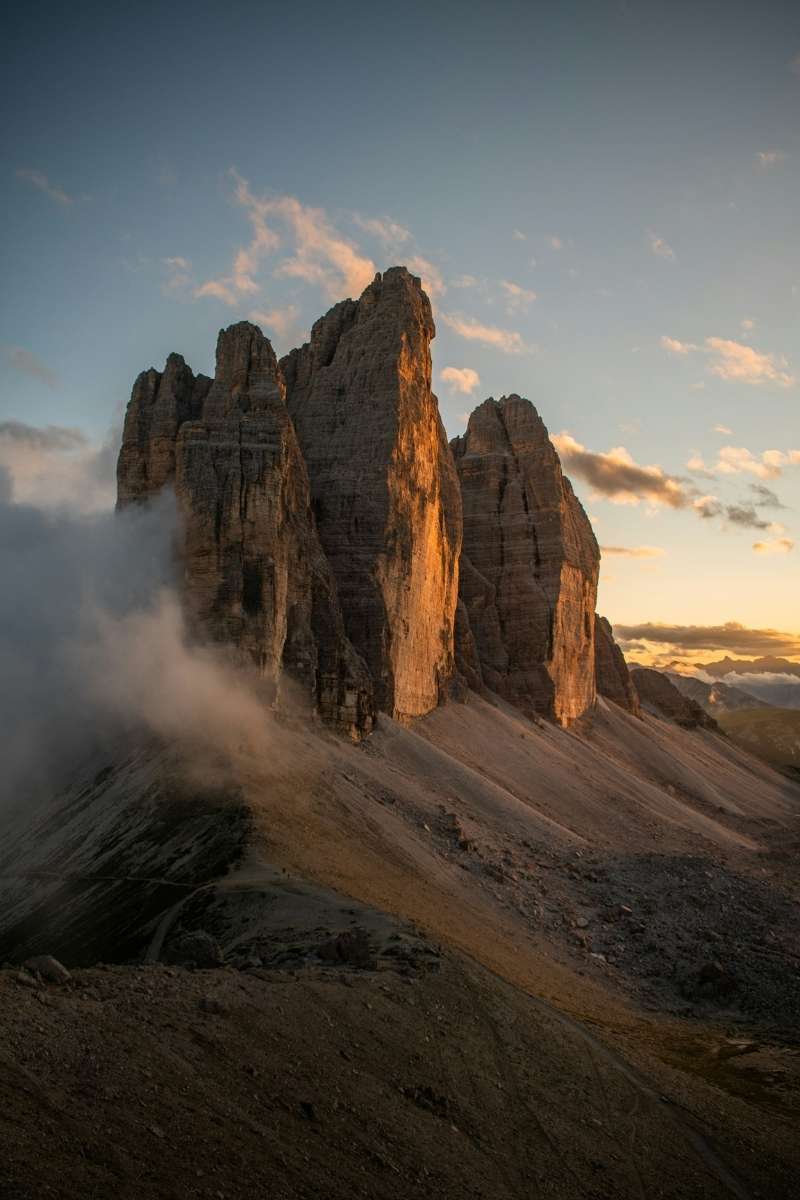
The three colossal stone towers of Tre Cime di Lavaredo (Drei Zinnen in German) are the single most iconic image in the Dolomites — three sheer monoliths rising side by side, instantly recognisable. The classic loop trail around them (roughly 10km, 3–4 hours, moderate) is one of the great day hikes on earth: relatively gentle, endlessly dramatic, dotted with rifugi and WWI tunnels.
Drive the toll road to Rifugio Auronzo to start high. Get there early — the parking fills by mid-morning in summer, and sunrise on the towers is unforgettable.
Lago di Braies (Pragser Wildsee)
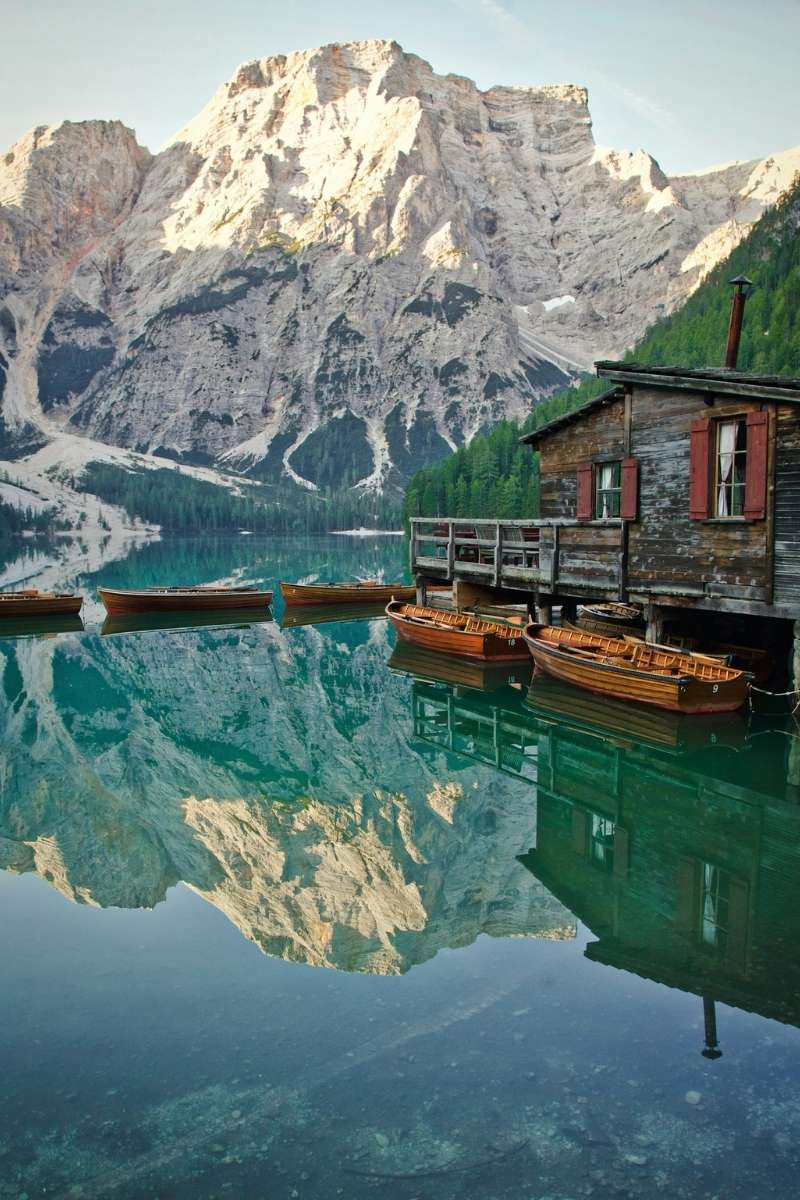
 The most photographed lake in the Alps, and despite the crowds, still genuinely breathtaking — a deep emerald-turquoise basin beneath sheer cliffs, with a famous wooden boathouse and rowboats for hire.
Get there before 8am or after 6pm. By mid-morning in summer it's overwhelmed, and access is now restricted by timed entry and shuttle in peak months — check current rules before you go. The lakeside loop trail (about 1.5 hours, flat) is easy and beautiful.
Seceda and Alpe di Siusi
Two of the great meadow experiences in the Alps, both in or near Val Gardena.
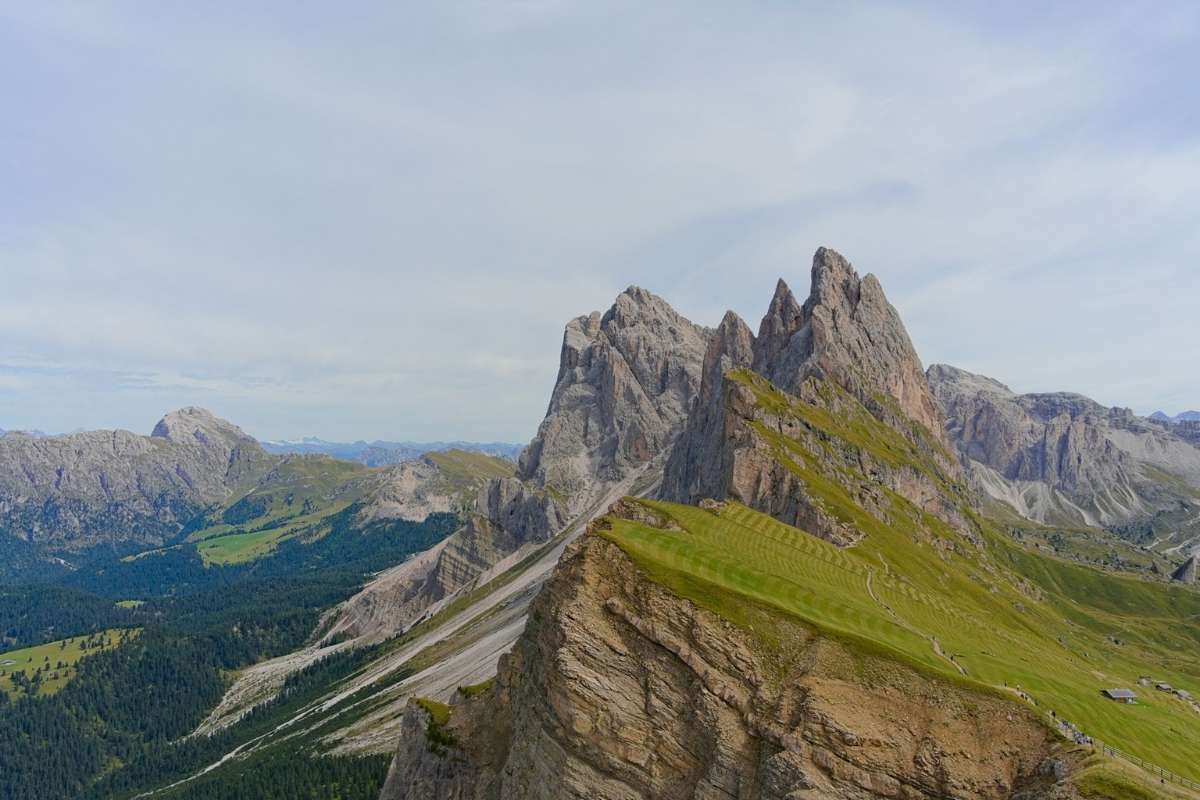
Seceda is the famous tilted ridgeline — a knife-edge of grass dropping to jagged peaks, reachable by cable car from Ortisei. The view from the top is one of the most photographed in the Dolomites for a reason.
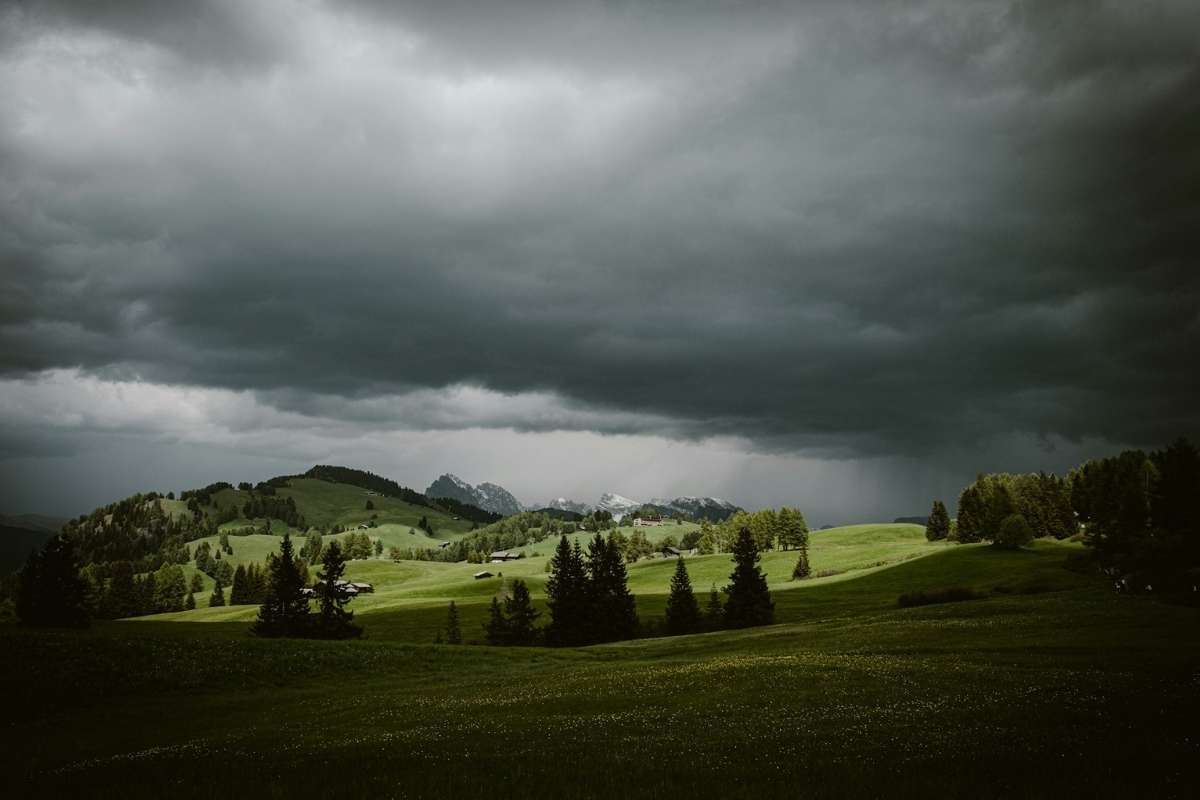
Alpe di Siusi (Seiser Alm) is the largest high-altitude alpine meadow in Europe — a vast, rolling green plateau beneath the Sassolungo and Schlern massifs, laced with gentle trails ideal for all abilities. Take the cable car up from Ortisei; the meadow is car-restricted during the day.
Val di Funes and the Church of St. Johann
If the Dolomites have a single postcard image, this is it: a tiny baroque church standing alone in a green meadow, the saw-toothed Odle/Geisler peaks rising behind it. The classic view is from the marked photo spot near St. Johann in Ranui; the gentle Adolf Munkel Trail beneath the Odle group is one of the loveliest easy hikes in the region.
The Sellaronda
In winter, the Sellaronda is a legendary full-day ski circuit looping around the Sella massif through four valleys and four mountain passes, entirely on linked lifts and pistes — a bucket-list day for any skier. In summer, the Sellaronda Bike Day and a network of via ferrata and trails open the same dramatic terrain to hikers and cyclists.
Via Ferrata and the WWI Front
The Dolomites were a brutal front line in the First World War, and the mountains are threaded with tunnels, trenches, and the iron-cabled climbing routes (vie ferrate) the soldiers built. The Lagazuoi tunnels above Cortina — a cable car up, a guided descent through wartime galleries blasted into the mountain — are an extraordinary, sobering half-day. For experienced scramblers with proper kit and a guide, the via ferrata are a thrilling way to access terrain otherwise reserved for climbers.
Cinque Torri and Lago di Sorapis
Cinque Torri ("five towers") near Cortina is a cluster of rock pinnacles surrounded by an open-air WWI museum of restored trenches, with one of the best easy panoramic loops in the region. Lago di Sorapis, reached by a more demanding trail (around 6–7 hours round trip, some exposure), rewards the effort with one of the most surreally milky-blue glacial lakes anywhere.
Bolzano and Ötzi the Iceman
When the weather turns, the regional capital of Bolzano is a delightful, sunny South Tyrolean city of arcaded streets and outdoor markets. Its South Tyrol Museum of Archaeology houses Ötzi — a remarkably preserved 5,300-year-old mummy found in a melting glacier in 1991, and one of the most important archaeological finds in Europe. Genuinely unmissable.
Where to Eat and Drink
The Dolomites punch absurdly above their weight — Italian technique, Austrian heartiness, Alpine ingredients, and a startling concentration of Michelin stars in tiny valleys.
Rifugio dining is the soul of the region. A long lunch on a mountain hut terrace — canederli (bread dumplings), speck (the local smoked ham), polenta with mushrooms, kaiserschmarrn (shredded sweet pancake) for dessert — with a 360° view of the peaks, is the definitive Dolomites meal. Almost every hut does this well; Rifugio Scotoni and Rifugio Averau are particular favourites.
Fine dining: Alta Badia is the gastronomic epicentre. St. Hubertus at Rosa Alpina (three Michelin stars under chef Norbert Niederkofler's "Cook the Mountain" philosophy) is a destination in itself. La Stüa de Michil in Corvara and AlpiNN at Plan de Corones offer more accessible high-end Alpine cuisine.
Tyrolean classics: Seek out a traditional Stube — a wood-panelled mountain dining room — for gulasch, Schlutzkrapfen (spinach-and-ricotta pasta pockets), barley soup, and Tris di canederli (a trio of dumplings).
Sweet: Apple strudel is everywhere and rarely disappointing. So is Linzer torte and kaiserschmarrn. Find a sunny terrace and don't resist.
Wine: South Tyrol is one of Italy's most underrated wine regions. Try crisp white Gewürztraminer and Kerner, and the distinctive local red Lagrein and lighter Schiava (Vernatsch). Many valley restaurants pour excellent local bottles by the glass.
Coffee: This is Italy — espresso is taken seriously even at 2,000 metres. A post-hike espresso on a rifugio terrace is its own small ritual.
Practical Tips
Get a guest card. Most valleys issue a free guest card with your accommodation (Südtirol Guest Pass, Dolomiti SuperSummer card, etc.) covering buses, sometimes cable cars, and discounts. Ask your hotel on arrival.
The cable cars do the climbing. Many of the best hikes start at the top of a lift, not in the valley. Build your itinerary around lift schedules and check seasonal opening dates carefully — they vary by valley and many close from mid-October to early June.
Book rifugi and key accommodation early. Mountain huts and the famous hotels fill months ahead for summer and the ski season. Reserve as far out as you can.
Layer ruthlessly. Mountain weather changes in minutes, even in July. A sunny morning hike can turn to cold rain or hail by afternoon. Always carry a waterproof shell, warm layer, and proper footwear, regardless of the forecast.
Respect the via ferrata seriously. These are not regular trails. They require a harness, via ferrata set, helmet, and ideally a guide if you're inexperienced. People are injured every year underestimating them.
Languages. German and Italian are both official in South Tyrol; Ladin survives in a few valleys. English is widely spoken in tourist areas. A few words of either Italian or German are warmly received.
Drive the passes — but carefully. The high mountain-pass roads are spectacular and a highlight in themselves, but they're narrow, winding, and shared with cyclists and motorcyclists in summer. Allow generous time and don't rush them.
Leave No Trace. This is a protected UNESCO landscape and a working alpine environment. Stay on marked trails, pack out everything, don't pick wildflowers, and close pasture gates behind you.
How Long Do You Need?
A long weekend (3–4 days): Time for one or two valleys — Tre Cime, a meadow day on Alpe di Siusi or Seceda, the Val di Funes viewpoint, and a couple of great rifugio lunches. You'll leave already planning the return.
One week: Base in two valleys, add Lago di Braies and Lago di Sorapis, a via ferrata or the Lagazuoi tunnels, a drive over the great passes, and a rainy-day trip to Bolzano. The sweet spot for a first visit.
Two weeks: Hut-to-hut trekking — the Alta Via 1 is the classic multi-day traverse — plus deep exploration of the lesser-known valleys, more via ferrata, and time to simply sit on a terrace and watch the enrosadira turn the peaks to fire, night after night.
There is no such thing as enough time in the Dolomites.
Final Thoughts
The Dolomites change your relationship with scale and with light. These mountains aren't backdrop — they're vertical, immediate, almost confrontational, rising so abruptly from the meadows that they don't seem to obey the usual rules of geography. And then, twice a day, they catch the sun and glow rose and copper and violet, and you understand why the people who live beneath them gave that moment its own word.
It's a place where three cultures have learned to share one extraordinary landscape — where the food, the language, and the architecture all carry that doubled, blended history, and where a mountain hut can serve you espresso and strudel in the same sitting without anyone finding it strange.
People who visit once tend to come back. People who come back start learning the difference between a Schiava and a Lagrein. People who keep coming back end up walking the same ridgeline every year, in every season, just to watch it change.
It will still manage to surprise you. Every single time.
Pack your hiking boots. Bring the good camera. Stay up for the alpenglow.
The mountains are waiting.


