Fall in NYC: The Complete Autumn Guide to New York City
March 29, 2026 · TripOnly

Fall in NYC: The Complete Autumn Guide to New York City
There's a version of New York that only exists for about eight weeks a year.
It starts in late September, when the first cool front comes through and the city collectively exhales. The humidity breaks. The light changes angle. People reappear on the streets in layers, holding coffee cups with both hands. Central Park starts turning — slowly at first, then all at once — and the elm trees along the Mall go gold in a way that makes even lifelong New Yorkers stop and take photographs they know won't do it justice.
Fall in New York City is, by some distance, the best time to visit. The summer crowds thin. The temperatures become cooperative. The food markets fill with apples and squash and cider. The city that can feel relentless in July becomes, briefly, somewhere you'd want to linger.
This is how to spend it well.
When to Go
Autumn technically begins in late September and runs through November, but the experience changes considerably across those weeks.
Late September to mid-October is warm by day and cool by night — jacket weather in the mornings, t-shirt weather by afternoon. The parks are still green with early colour appearing. The city is busy but not overwhelmingly so. This is the window for outdoor activities, rooftop bars, and walking without a destination.
Mid to late October is peak foliage season. Central Park reaches full colour around the third week of October — the elms, maples, and sweetgums turning simultaneously across the 843 acres in a display that makes the park feel designed for the moment. This is also Halloween season, which New York handles with considerable enthusiasm and its own specific character.
November is quieter, cooler, and underrated. The leaves are mostly down but the city takes on a more contemplative atmosphere. The food scene shifts into its winter register — braised things, roasted things, the first batches of whatever the new restaurants have been planning since summer. Thanksgiving at the end of the month brings the Macy's Parade and, if you're staying, the particular New York experience of the city half-empty and half-festive simultaneously.
The Parks
The parks are the reason to be in New York in fall, full stop. The city's green spaces, which spend much of the year as relief from the concrete, become destinations in themselves when the colour comes.
Central Park is the obvious starting point and earns the attention. The Mall — the long, formal promenade lined with American elms that runs through the centre of the park — is the single best foliage walk in the city. The elms arch overhead and in mid-October the light filters through gold and amber in a way that's been photographed millions of times and still manages to feel personal when you're standing in it.
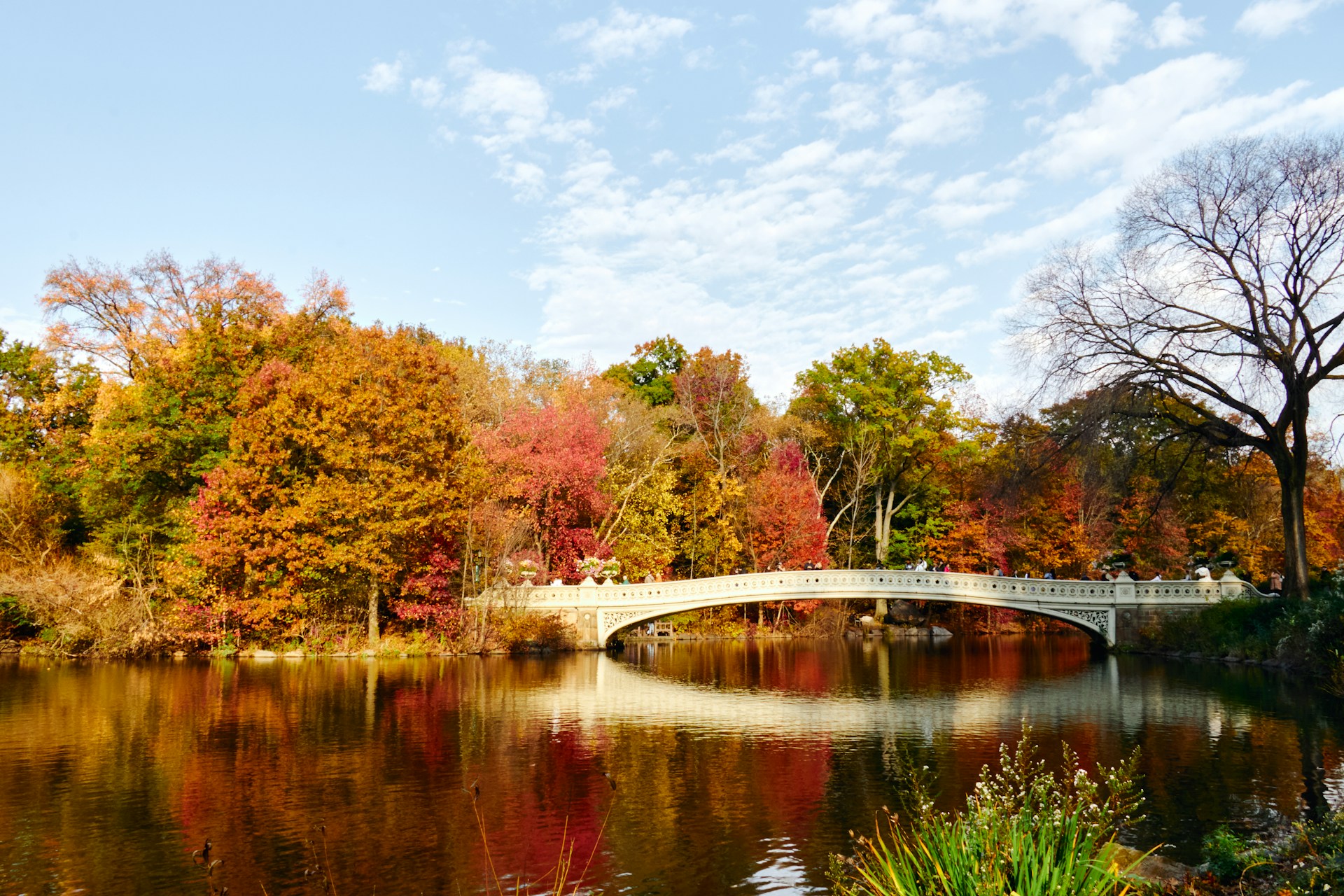
Less visited: the Ramble, a 36-acre woodland section in the middle of the park that was designed to feel wild and largely succeeds. In autumn it becomes a serious birdwatching destination — the park sits on the Atlantic Flyway and migrating warblers, thrushes, and hawks pass through in numbers that draw birders from across the region. You don't need to be a birder to appreciate the Ramble in October. You just need to slow down enough to notice what's happening in the trees.
Belvedere Castle, on the rocky outcrop above Turtle Pond, offers the best elevated view of the park's colour — the Great Lawn and the Ramble spreading south and east, the skyline visible above the treeline. Arrive early morning for the light and the relative absence of people.
Prospect Park in Brooklyn is what Central Park's more relaxed sibling looks like in autumn. The Long Meadow — at 90 acres, one of the largest open meadows in any urban park in the US — is magnificent in October light. The Ravine, Brooklyn's only remaining forest, goes full colour in late October and feels genuinely remote for something 45 minutes from Midtown Manhattan. The park draws significantly fewer visitors than Central Park and the experience is correspondingly more peaceful.
The High Line becomes one of the city's most cinematic walks in autumn. The elevated park, built on former freight rail tracks running through Chelsea and the Meatpacking District, was planted with grasses, perennials, and shrubs that deliberately shift through the seasons. In fall the plantings turn bronze and copper and the views of the Hudson River and the west side of Manhattan take on a quality of light that the summer heat flattens. The art installations along the path change seasonally and are consistently worth the detour.
The New York Botanical Garden in the Bronx is worth a specific trip. The Thain Family Forest — 50 acres of old-growth woodland, the largest remaining tract in New York City — reaches its peak colour in late October and early November. The contrast between the formal gardens and the old forest, both transformed by the season, makes a full afternoon easily. Check their events calendar for seasonal programming, which tends to be genuinely good.
The Food and Markets
New York's food scene operates at a sustained level of quality that makes fall eating here feel less like a seasonal shift and more like a concentrated version of what the city does all year — but with the specific pleasures of the harvest added.
The Union Square Greenmarket is the city's best farmers' market and in October it is at its spectacular peak: heirloom apple varieties stacked in crates, pie pumpkins, ornamental gourds, the last of the tomatoes, the first of the root vegetables, honey, cider, farmhouse cheese. It runs Monday, Wednesday, Friday, and Saturday at the north end of Union Square Park. On a Saturday morning in mid-October, it's one of the most specific New York experiences available at no cost.
Apple cider is the correct drink of fall in New York State, and the greenmarket sells it in gallon jugs that you will carry across the city feeling like someone who has things figured out. The orchards of the Hudson Valley and the Catskills ship varieties of cider that don't exist in supermarkets — dry, tannic, deeply apple-flavoured, sometimes sparkling.
The restaurant scene shifts in a way that rewards paying attention. The city's best chefs tend to release their most ambitious autumn menus in October: braised game, root vegetable preparations, mushroom dishes built around the extraordinary variety coming out of the northeast forests. Reservations that were impossible in August become findable. The terraces that were overcrowded in July are now the right temperature and occupied by people who actually want to be outside.
Essex Market on the Lower East Side, relocated to its new home on Delancey Street, is worth a visit for its concentration of food vendors — smoked fish, pickles, Eastern European deli items, excellent coffee — that collectively represent a strand of New York food culture that's worth preserving and eating.
Halloween
New York does Halloween with a seriousness that approaches civic pride.
The Greenwich Village Halloween Parade on October 31 is one of the largest and most genuinely strange public events in the city — a procession of costumes, puppets, floats, and performers that takes over Sixth Avenue for several hours and attracts both participants and spectators in the hundreds of thousands. The parade has run since 1974 and has developed its own aesthetic: large-scale, theatrical, politically irreverent, occasionally overwhelming. Arrive early to claim a viewing spot on Sixth Avenue between Spring and 21st Street. The energy is unlike anything else in the city's annual calendar.
Beyond the parade: the city's outer boroughs and surrounding areas become genuinely autumnal in ways that Manhattan, being Manhattan, sometimes forgets to be. Sleepy Hollow, about an hour north of the city by Metro-North, takes its Washington Irving heritage seriously in October — ghost tours, candlelit events, the Headless Horseman. It's slightly touristy and entirely appropriate.
Governors Island hosts a pumpkin festival in October that combines the visual spectacle of thousands of pumpkins with an improbable view of the Manhattan skyline across the harbour. It's free to enter (ferry ticket required) and offers a perspective on the city that very few visitors find.
Culture and Events
Fall is Broadway's most important season. The new season opens in September and October, and the combination of new productions and returning shows makes autumn the best window for theatre. Preview performances — cheaper than official opening nights — run through most of September and October and offer full productions at reduced prices.
The major museums shift their programming for autumn: the Met, MoMA, the Whitney, the Guggenheim all tend to open their significant new exhibitions in September and October, timed to coincide with the influx of visitors. The autumn light in the museum districts — Fifth Avenue, the Upper West Side, the Lower East Side — makes the walks between institutions pleasant in their own right.
New York Comic Con takes over the Javits Center for four days in early October, drawing 200,000 attendees and producing a city-wide costumed atmosphere that spills out of the convention centre into the surrounding streets and subway stations. If you're not a participant, the people-watching from the High Line or the Chelsea Piers waterfront is significant.
The New York Film Festival at Lincoln Center runs through September and October, presenting a programme of international cinema that consistently includes the most talked-about films of the year before their wider release. Tickets are limited but available; the screenings in the main Alice Tully Hall are worth attending for the space as much as the films.
Neighbourhoods for Autumn Walks
Some parts of the city reward aimless walking in autumn more than others.
Brooklyn Heights and the Brooklyn Heights Promenade offer the most famous view of the Manhattan skyline from the water side, framed in October by the changing trees of the promenade itself. The neighbourhood's brownstones and quiet residential streets behind the promenade are some of the most architecturally consistent in New York — the kind of blocks that make the city feel like it has been considered rather than accumulated.
Cobble Hill and Carroll Gardens in Brooklyn, walking south from Brooklyn Heights, are a continuation of that residential quietness — antique bookshops, Italian bakeries, wine bars that open in the afternoon, the kind of neighbourhood pace that Manhattan mostly gave up decades ago.
The West Village in Manhattan is at its best in autumn, when the trees on the residential streets — Barrow, Commerce, Grove — go gold and the neighbourhood's scale, which is human rather than monumental, feels exactly right. The combination of the architecture, the pace, and the seasonal light makes it the most walkable neighbourhood in the city by a considerable margin in October.
Fort Tryon Park and The Cloisters at the northern tip of Manhattan are the city's most undervisited combination. The park sits on a ridge above the Hudson with views north along the river toward the Palisades — a genuinely wild-feeling landscape that is somehow still within the city limits. The Cloisters museum, housing the Metropolitan Museum's medieval collection in a reconstructed monastery, is extraordinary in any season and particularly atmospheric on grey October afternoons.
Practical Things Worth Knowing
The weather is variable. A week in early October might be 75°F and sunny; a week in late October might be 45°F and rainy. Pack for both. The city is fully operational in all conditions and some of the best autumn days are overcast — the light is flatter but the colours read differently and the parks are considerably less crowded.
Book accommodation early for October. The combination of foliage season, cultural events, and school break travel makes mid-October one of the most heavily booked periods in the New York hotel calendar. Prices reflect this.
Use the subway. The city's outer-borough parks — Prospect Park, the Botanical Garden, Fort Tryon — are all accessible by transit without a car. The subway is faster than rideshare in most situations and the walk from the station is part of the experience.
The peak foliage window is narrow. In Central Park it typically runs for about two weeks — the third and fourth weeks of October in a normal year. Check the New York City Parks Department foliage tracker, which is updated weekly through the season, if timing is important to you.
Why Fall Is the Right Time
New York is one of those cities that is always worth visiting and always slightly exhausting — a place that gives you everything and asks a great deal in return. In summer it can feel relentless. In winter it requires commitment. In fall it becomes, briefly, a city you could imagine living in rather than just passing through.
The light is different. The pace is different. The parks are full but not overwhelming. The restaurants are at their best. The cultural season is in full swing. The air carries the smell of fallen leaves over the smell of everything else.
Come in October. Stay longer than you planned.
New York in autumn will justify the decision.


