Marrakech Travel Guide: Spice, Labyrinth & the City That Never Quite Lets Go
April 10, 2026 · TripOnly

Why Marrakech Is Unlike Anywhere Else
There is a concept in Arabic — tarab — a kind of ecstatic transport brought on by music, beauty, or overwhelming sensation. Marrakech produces something close to it in almost every visitor. You arrive expecting a city and find something more like an alternate reality: a medieval maze of streets that has absorbed a thousand years of traders, scholars, pilgrims, and conquerors without losing an ounce of its essential strangeness.
This is a place where tanneries still function as they did in the 11th century, where the world's most famous square transforms from a fruit market in the morning to a smoky carnival of storytellers and snake charmers by night, where riads — those plain-walled courtyard houses — conceal interiors of almost hallucinatory beauty behind unmarked wooden doors. Marrakech is simultaneously ancient and sharply, unexpectedly modern. It is a contradiction that somehow holds.
It rewards patience and curiosity and punishes anyone who tries to rush through it. Get lost deliberately. Accept the chaos. Let the city show you what it wants to show you.
When to Go
March–May is the finest window — warm without the furnace heat of summer, the almond and orange trees in bloom, the light in the medina at its most golden. Temperatures hover around 20–26°C. The crowds are manageable. This is Marrakech at its most generous.
October–November runs a close second. The summer heat has broken, the days are still long and warm, and the city feels alive in a quieter way. Dates are harvested in the oases south of the city. The Saharan day trips are spectacular at this time of year.
June–August is extreme. Temperatures regularly exceed 40°C in the medina. The souks become stifling. Most Moroccan families leave for the coast. Only visit in summer if you have air conditioning, a pool, and very low ambitions for walking. Mornings are the only tolerable time outdoors.
December–February is cool and occasionally rainy, with temperatures dropping to 5–10°C at night — colder than most first-timers expect. But the city is quieter, the riads have fires lit, and the Atlas Mountains above the city are snow-capped. A beautiful and underrated time to visit.
Getting There & Around
By Air: Marrakech Menara Airport (RAK) sits 6 km southwest of the medina, served by direct flights from most major European cities and Casablanca. Taxis from the airport are cheap and metered — agree on the fare in advance or insist on the meter. The journey to the medina takes around 15 minutes.
Getting Around:
- On foot: The medina is the only way to truly experience it — the streets are too narrow and irregular for vehicles in most parts. Wear comfortable shoes and accept that you will get lost. This is not a problem; it is the entire point.
- Calèches (horse-drawn carriages): The traditional way to travel between the medina and the Ville Nouvelle. Romantic, slow, and entirely charming. Negotiate the price before getting in.
- Petit taxis: Small orange taxis that operate within the city. Meters exist but are rarely used — agree the fare in advance. Essential for reaching the Palmeraie or Ville Nouvelle from the medina.
- Uber / Careem: Both operate in Marrakech and remove the negotiation entirely. Particularly useful after dark or for airport runs.
- Bikes and scooters: Available to rent and increasingly popular for reaching outlying gardens and the Agdal reservoir area. Not recommended inside the medina itself.
Neighbourhoods to Know
The Medina — The Living History
The walled old city is where Marrakech's soul lives, and it hasn't fundamentally changed in centuries. Two square kilometres of souks, mosques, madrasas, hammams, and residential alleyways where strangers in elaborate embroidered djellabas pass within centimetres of you on streets barely a metre wide. The medina is divided roughly into the commercial quarters (the souks), the Djemaa el-Fna and surrounding area, and the quieter residential sectors around Mouassine and Riad Zitoun. Most riads and most of what visitors come to see are within these walls.
Djemaa el-Fna — The Heartbeat
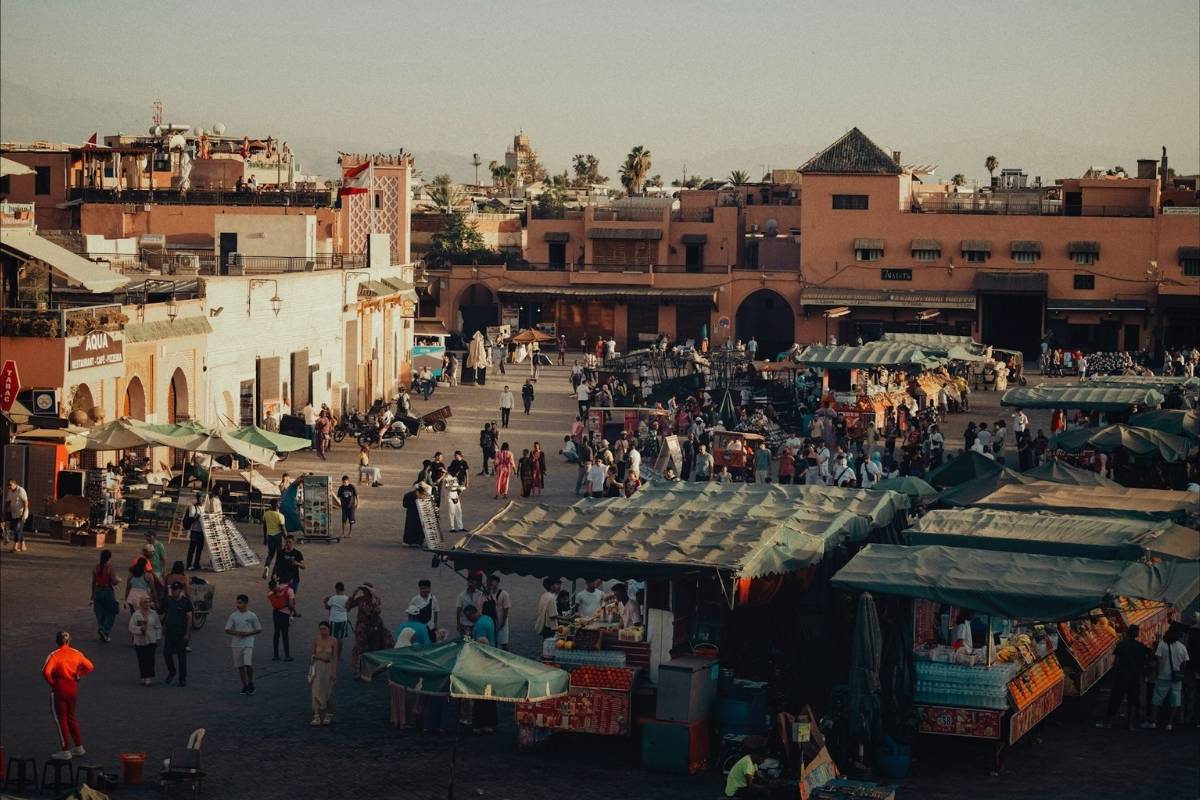
Technically a square — technically — but more accurately a stage set that reinvents itself every few hours. In the morning: fresh orange juice vendors, dried fruit sellers, argan oil merchants. By afternoon: acrobats, henna artists, storytellers, musicians. By evening: the famous food stalls are lit up, smoke billowing from dozens of tagine grills, the entire square vibrating with sound. Sit on a rooftop terrace above it at dusk and watch the transformation happen. UNESCO called it a Masterpiece of the Oral and Intangible Heritage of Humanity. For once, the designation understates the case.
The Souks — The Labyrinth
The great market quarter stretching north from Djemaa el-Fna is one of the most extraordinary commercial spaces in the world. Each alley specialises in something: leather here, spices there, carpets in one corridor, lanterns in the next, the sound of hammering copper announcing the ironworkers' quarter. You will get lost. Someone will inevitably offer to show you the way — for a small consideration — and their detour will take you through their cousin's carpet shop. Accept all of this with good humour. The souks reward those who treat them as a destination rather than a transaction.
Mouassine — The Design Quarter
Just west of the main souk arteries, Mouassine has become Marrakech's most aesthetically curated quarter — where the city's best concept stores, art galleries, and independent restaurants have settled. The 16th-century Mouassine Mosque and its attached fountain are among the medina's quietest architectural gems. This is where Marrakech's creative class has established itself, and it's a welcome counterpoint to the hustle of the central souks.
Mellah — The Jewish Quarter
The old Jewish quarter southeast of Djemaa el-Fna is one of the medina's most atmospheric and least-visited areas. The distinctive covered market street, the synagogues, and the balconied houses speak to a Jewish Moroccan community that was once twenty thousand strong and is now largely absent. The nearby El-Badii Palace ruins and the Saadian Tombs make this a logical circuit for a half-day of history.
Gueliz (Ville Nouvelle) — The Modern City
The French-built new town west of the medina is where Marrakech's restaurants, cafés, galleries, and international hotels cluster. It is calmer, wider, and more navigable than the medina — a useful counterweight after days of sensory overload. The Jardin Majorelle is technically here, though just at the edge. Gueliz rewards a slow afternoon: the art galleries on Rue de la Liberté, a long lunch at one of the pavement restaurants, a coffee at a terrace café watching the Marrakchis go about their lives.
The Palmeraie — The Oasis
Three kilometres north of the medina, the ancient palm grove that surrounds the city has been transformed into a zone of luxury hotels, private villas, and wellness retreats. Not essential for first-time visitors, but the contrast — oasis palms and silence after the medina's intensity — is genuinely startling.
The Essential Sights
Djemaa el-Fna
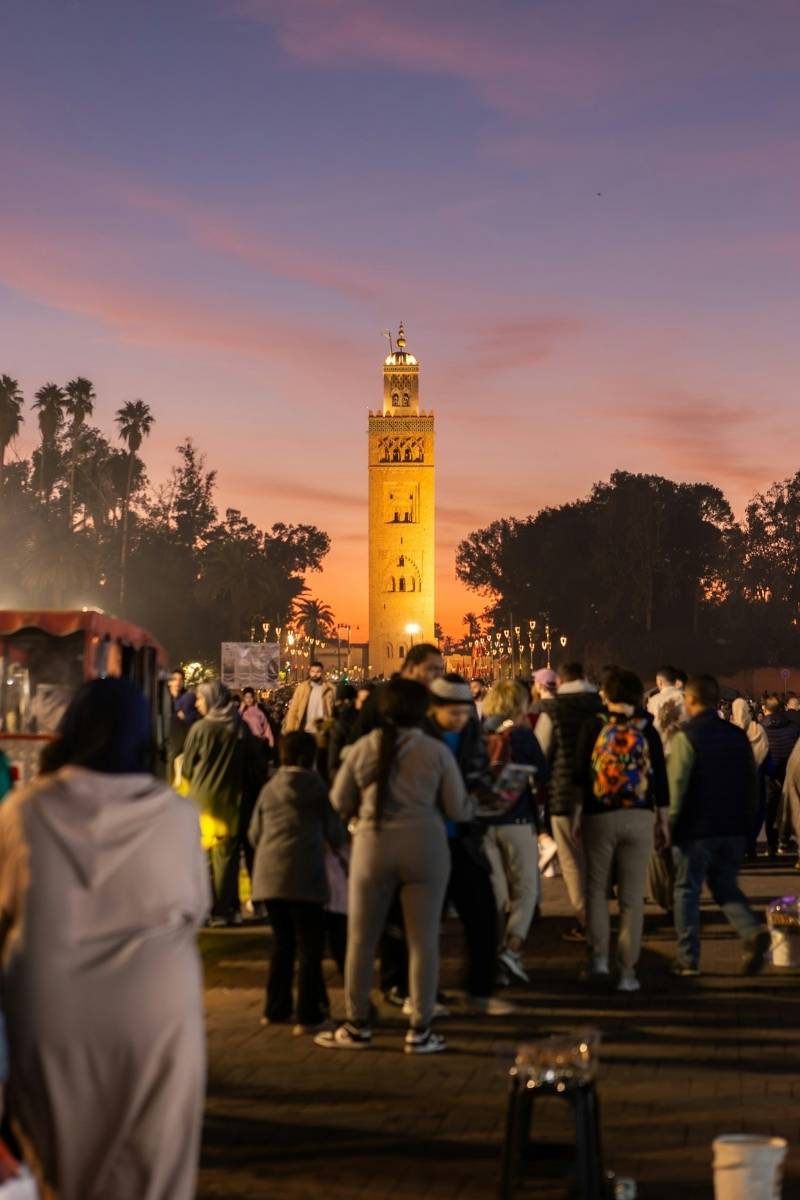
Already described above, but it bears repeating: do not treat this as a sight to check off. Come back multiple times, at different hours. The square at 7am, buying fresh orange juice from the rows of vendors, bears no resemblance to the square at 10pm, lit by gas lamps, the smell of grilled meat in the air, a gnawa musician leading a trance circle in the corner. Both are real. Both are essential.
The Saadian Tombs
Sealed by the Alaouite sultan Ahmed al-Mansour in the 17th century and only rediscovered in 1917, the tombs of the Saadian dynasty are among the finest examples of Moroccan decorative art anywhere. The Chamber of the Twelve Columns — carved cedarwood, zellige tilework, and stucco arabesques — is overwhelming in its detail. Go early; queues build quickly.
Bahia Palace
A 19th-century vizier's palace assembled over decades, the Bahia contains some 150 rooms, gardens, and courtyards, all decorated with the finest artisans of the era. The name means "brilliance," and the marble-floored rooms of the harem, with their painted cedarwood ceilings and walled orange-blossom gardens, justify it. The audio guide is helpful for understanding what you're seeing.
El-Badi Palace
The "Incomparable Palace" — built by the same Ahmed al-Mansour who sealed the Saadian Tombs, decorated with Italian marble and Sudanese gold, once considered one of the wonders of the world. Today it is a magnificent ruin: enormous open courts, sunken gardens, panoramic rampart walks, and the storks that nest on every surviving wall. More atmospheric for being broken than it would be if it were whole.
Medersa Ben Youssef
The largest Quranic college in North Africa when it was built in the 14th century, beautifully restored and now open to visitors. The central courtyard — a marble reflecting pool flanked by carved stucco walls rising three storeys to a cedar pergola — is one of the most beautiful interior spaces in Morocco. Arrive at opening time; the light through the upper galleries in the morning is extraordinary.
Jardin Majorelle
The electric-blue garden created by French artist Jacques Majorelle in the 1920s and rescued from demolition by Yves Saint Laurent in 1980. The cobalt blue is more vivid in person than in any photograph. The gardens are botanical as well as architectural — bamboo groves, cactus gardens, bougainvillea cascading over studio walls. The adjacent Berber Museum, housed in the original studio, is among the finest small museums in Morocco. Book tickets online; it sells out.
The Tanneries
In the leather quarter north of the souks, the Chouara tanneries have functioned since the 11th century, and the process of treating and dyeing hides has not fundamentally changed. The views from the surrounding terrace balconies — circular stone vats of coloured dye, workers knee-deep in them — are arresting. The smell is equally memorable. The merchants who own the surrounding leather shops will offer you a sprig of mint as you climb to the terrace; accept it gratefully.
Food & Drink
Moroccan food is one of the world's great cuisines, and Marrakech is its most concentrated expression.
Tagine is the foundation — slow-braised meat or vegetables in a conical clay pot, perfumed with saffron, preserved lemon, olives, cinnamon, and ras el hanout. The lamb-and-prune tagine is the canonical version; the chicken-with-preserved-lemon is arguably the more elegant one. Eat tagine at a small neighbourhood restaurant in the souks rather than the tourist-facing establishments on Djemaa el-Fna: the cooking is better and the prices a fraction.
Couscous is served on Fridays across the city — the traditional meal following the midday prayers. A proper Friday couscous with seven vegetables and braised lamb, eaten in a family restaurant, is one of the finest food experiences in Morocco.
Pastilla — the sweet-savoury pigeon (or chicken) pie wrapped in paper-thin warqa pastry and dusted with cinnamon and icing sugar — sounds improbable and tastes magnificent. Order it with 24 hours' notice at the better restaurants.
Street food on Djemaa el-Fna: The stalls are not primarily for tourists; they feed the city's night workers. Merguez sandwiches, harira soup, snail broth (don't ask, just drink), sheep's head. Eat standing. Point at what others are eating.
Mint tea: The negotiation ritual of Marrakech. Poured from a height, extremely sweet, offered at every shop, every riad, and every negotiation. Refusing is impolite; accepting commits you to nothing except fifteen minutes of pleasant conversation.
Alcohol: Morocco is a Muslim country; alcohol is available but not prominent. The better restaurants and most riads are licensed. Do not expect to find a bar on every corner. What you lose in nightlife options you more than gain in the quality of the food culture.
Hammams
A hammam is not optional. It is the mechanism by which Marrakech restores you after the sensory intensity of the souks. There are two kinds.
Traditional hammams — neighbourhood bathhouses used by locals — charge a few dirhams for entry and provide the most authentic experience. The ritual is simple: steam room, exfoliation with a kessa mitt, black soap massage, cold rinse. The Hammam Bab Doukkala and Hammam Mouassine are the most accessible for visitors without Arabic.
Riad hammams and spa hammams — the luxury version, with aromatherapy oils, private cabins, and English-speaking staff. The experience is gentler and more expensive. Excellent after a long day of walking; less culturally interesting than the traditional version.
Go in the late afternoon, before dinner. You will emerge a different person.
Shopping
The souks exist to sell things, and selling things is done here with artistry, patience, and theatrical flair. A few principles help.
Never pay the first price. The opening figure in a negotiation is a starting point, not an offer. Thirty to fifty percent off is standard for most goods; occasionally more. The haggle is a social ritual, not a confrontation — enjoy it.
Know what you want before you enter a carpet shop. The carpet merchants of Marrakech are among the finest salespeople in the world, and their enthusiasm for hospitality (tea, conversation, the gradual unrolling of increasingly beautiful rugs) is entirely genuine and entirely designed to make leaving without buying feel rude. It isn't. But it's easier to resist if you've decided in advance.
Best buys: Argan oil (from a women's cooperative, not a souk stall), handmade leather goods, zellige tilework and ceramics, hand-knotted rugs from the Atlas and the south, embroidered textiles, spice blends (buy them whole, not pre-ground).
The Ensemble Artisanal near Bab Nkob has fixed prices and quality-controlled products — useful for calibrating costs before diving into the souks proper.
Day Trips Worth Taking
The Atlas Mountains & Imlil
An hour's drive southeast of Marrakech, the High Atlas rises dramatically from the plains. The village of Imlil, at 1,740 metres, is the base for trekking to Jbel Toubkal — at 4,167 metres, the highest peak in North Africa. Even without climbing, the drive through Berber villages, terraced walnut orchards, and the Ourika Valley is extraordinary. A half-day excursion; a multi-day trek for the serious hiker.
Essaouira
Three hours west on the Atlantic coast, Essaouira is everything Marrakech is not: breezy, whitewashed, and languid, its 18th-century Portuguese-Moroccan fortifications running directly into the sea. Excellent fresh seafood, a small but excellent arts scene, and winds that make it the windsurfing capital of Africa. One night minimum — a day trip doesn't do justice to its particular atmosphere.
Ait Ben Haddou
Three hours southeast over the Tizi n'Tichka pass, this UNESCO-listed ksar (fortified village) is the most photogenic example of earthen architecture in Morocco and has served as the backdrop for everything from Lawrence of Arabia to Game of Thrones. Combine with Ouarzazate, Morocco's "Hollywood," for an overnight. The drive over the pass is itself spectacular.
The Agafay Desert
Only 40 km from Marrakech, the rocky Agafay plateau offers the aesthetic experience of the Sahara — hammada desert, distant Atlas peaks, total silence — without the 500-kilometre drive to the sand dunes at Merzouga. Excellent luxury desert camps operate here. A sunset camel ride followed by dinner under the stars is exactly as good as it sounds.
Safety
Marrakech is a very safe city by the standards of any major world destination. The vast majority of visitors experience nothing more threatening than persistent sales attention.
The faux guide problem: Men will approach you in the medina offering to show you around, claiming the souk you're looking for is "closed today" or that your riad is "in another direction." Most of these approaches are benign but will result in a detour to a friend's shop. Simply say no firmly and keep walking. The city's official tourist police (brigade touristique) are visible throughout the medina and responsive to genuine problems.
Practical rules:
- Keep bags closed and worn across the body in the souks
- Agree taxi fares before getting in
- Dress modestly, especially away from the tourist-facing areas — shoulders and knees covered
- Photography of people requires permission; in the tanneries and souks, tips are expected
- Do not change money on the street; use bank ATMs
Marrakech rewards those who engage with it confidently and directly, without either naivety or hostility. The city's people are genuinely hospitable — the sales pressure is a surface phenomenon over an underlying warmth that becomes apparent the moment you step off the main tourist circuit.
Practical Tips
- Currency: Moroccan Dirham (MAD). The dirham is a closed currency — exchange euros or dollars on arrival at the airport or at bank bureaux in Gueliz. ATMs are widespread and reliable.
- Language: Darija (Moroccan Arabic) and Tamazight (Berber) are the languages of daily life; French is widely spoken in hotels, restaurants, and Gueliz. A few words of French go a long way. "Shukran" (thank you in Arabic), "la shukran" (no thank you — essential in the souks), "b'saha" (to your health) — use them.
- Dress: Morocco is a conservative Muslim country. Cover shoulders and knees in the medina and away from tourist spaces. This applies to all genders. In your riad or a licensed restaurant, dress as you would anywhere.
- Tipping: Expected and appreciated throughout. Ten percent in restaurants, 10–20 dirham for a guide or porter, 5–10 dirham for hammam attendants.
- Wi-Fi: Universally available in riads and cafés. Local SIMs are cheap and easy to acquire at the airport.
- Prayer times: Five times daily, the call to prayer will reshape whatever you're doing. Embrace it. Mosques are not open to non-Muslim visitors in Morocco, but their exteriors and surrounding atmosphere are part of the city's fabric.
- Time zone: Western European Time (WET), UTC+0 in winter; Morocco observes daylight saving so check current offset. One hour behind Spain despite being directly south.
- Health: Food safety standards in licensed restaurants and riads are high. Exercise the usual caution with street food and unpeeled fruit. Tap water is technically potable in Marrakech but bottled water is universally used. Pharmacies are excellent and well-stocked.
Where to Stay
A riad in the medina is the essential Marrakech experience. These courtyard houses — a blank exterior wall, a studded wooden door, then a garden of orange trees, a tiled fountain, a rooftop terrace with Atlas views — are the finest accommodation the city offers. Dozens have been beautifully restored. Book riads directly where possible; the best ones fill months in advance for spring and autumn.
Mouassine and Bab Doukkala are the quietest and most atmospheric medina neighbourhoods for a riad stay — close enough to the souks, far enough from the noise of Djemaa el-Fna.
Near Djemaa el-Fna is convenient for first-time visitors but noisier — the square generates sound until well past midnight. Worth it for the immediacy; invest in earplugs.
Gueliz (Ville Nouvelle) offers international hotel brands, easier logistics, and a quieter base. Excellent if you're attending a wedding or a business trip that happens to be in Marrakech; slightly beside the point for a leisure visit.
The Palmeraie for luxury retreat: private pool, silence, total separation from the city. Beautiful — but you'll be in Marrakech without ever really being in it.
Final Thoughts
Marrakech asks something specific of you: it asks you to give up control.
Not in a dangerous way — in the best possible way. To stop trying to navigate and let yourself be absorbed. To sit in the shade of a fig tree in a riad courtyard for two hours doing nothing. To follow an alley because it smells interesting, not because it's on a map. To drink the third glass of mint tea even though you weren't thirsty for the first.
The city has been doing this to visitors for a thousand years. Traders from Timbuktu and Fez, scholars on pilgrimage, Sufi mystics, 20th-century artists escaping Europe, a generation of travellers who arrived in the 1960s and never quite left. They all felt what you will feel: that Marrakech has a specific gravity that is difficult to explain and impossible to resist.
Sit in Djemaa el-Fna on your last evening. Watch the smoke from the food stalls rise into the violet sky. Listen to the gnawa musicians. Order a final glass of orange juice from the row of vendors at the edge of the square — freshly squeezed, cold, absurdly cheap.
The longing starts somewhere over the Mediterranean on the flight home. Make sure you've earned it.


