Herceg Novi, Montenegro: The Bay of Kotor's Best-Kept Secret
June 4, 2026 · TripOnly

The Town the Bay Forgot
Herceg Novi sits at the westernmost point of the Bay of Kotor, where the bay's entrance channel is so narrow — less than 400 metres across — that you can watch the ferries threading between the two shorelines from a café table. Founded in 1382 by the Bosnian king Tvrtko I, the town has been ruled by the Ottomans, the Hungarians, the Spanish, the Venetians, and the Austro-Hungarians, each of them leaving something behind: a tower here, a gate there, a fountain, a loggia, a particular way of arranging a square.
The result is a town that doesn't quite look like anywhere else on the Adriatic — not as polished as Dubrovnik, not as dramatic as Kotor, not as deliberately rustic as the villages further up the bay. Herceg Novi is a real town, lived in and slightly rumpled, with a seafront promenade that locals actually use and a market that actually sells vegetables.
It also has more sunshine than almost anywhere else in Europe — around 240 days a year. The Montenegrins call it the Town of Sun and Mimosa, and in February, when the mimosa trees along the promenade bloom yellow and the rest of Europe is still grey, the nickname earns its keep.
Getting There
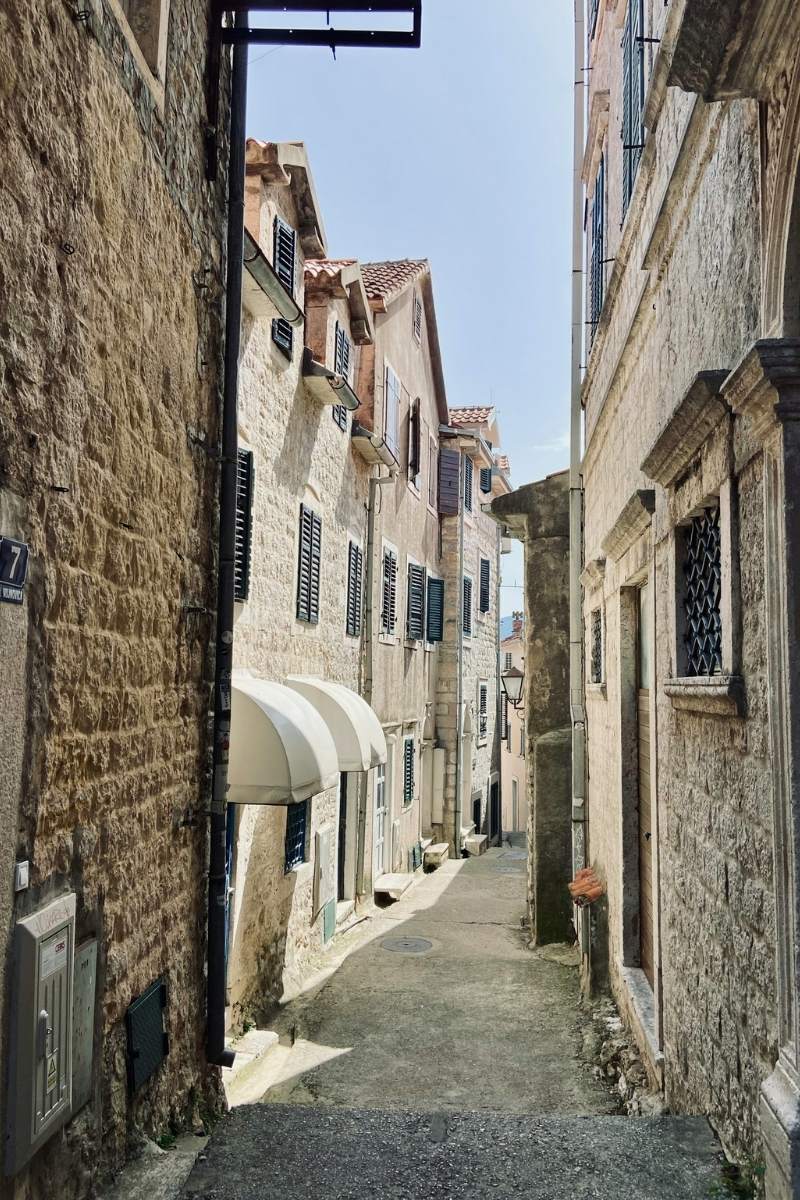 Herceg Novi is the first significant town you reach entering Montenegro from Croatia, which makes it either a natural first stop or a place people drive straight through on the way to Kotor and Budva. Drive through it, and you will regret it.
By car from Dubrovnik: About 45 minutes, crossing the border at Debeli Brijeg. The Croatian-Montenegrin border can back up in July and August — cross early in the morning or late in the evening. The drive along the Croatian coast before the border, and the descent into the bay after it, is one of the finer drives in the region.
By bus: Regular coach services connect Herceg Novi to Dubrovnik, Kotor, Budva, and Podgorica. The bus station sits on the main road above the old town; from there it's a short walk or taxi ride down to the seafront.
By ferry: A passenger and car ferry crosses the bay mouth between Kamenari (on the northern shore) and Lepetane (south), cutting out the long drive around the bay. If you're coming from Kotor, this is the most direct route — and the most scenic.
By air: The nearest airports are Dubrovnik (Croatia) and Tivat (Montenegro), both roughly 45 minutes away by car or bus transfer.
When to Go
May and June are ideal. The sea is warm enough to swim by late May, the town is operating at full stretch, and the summer crowds have not yet peaked. The light in early June — long evenings, the bay going flat and golden — is exceptional.
September and October are arguably better. The heat softens, the water is at its warmest after a full summer of sun, and the town exhales. Restaurants are still open, prices drop, and you get Herceg Novi largely to yourself.
July and August are hot, busy, and fully alive. The promenade fills with families, the beach bars run until 2am, and the town leans into its Adriatic resort identity without apology. It is a different experience — noisier, more social, more colourful — but not a worse one.
Winter and spring are for a specific kind of traveller: someone who wants an almost-empty Adriatic town, mild temperatures by continental standards, and the mimosa festival in February, when the whole promenade turns yellow and the town holds a carnival that has been running for over sixty years.
What to Do
Get Lost in the Old Town
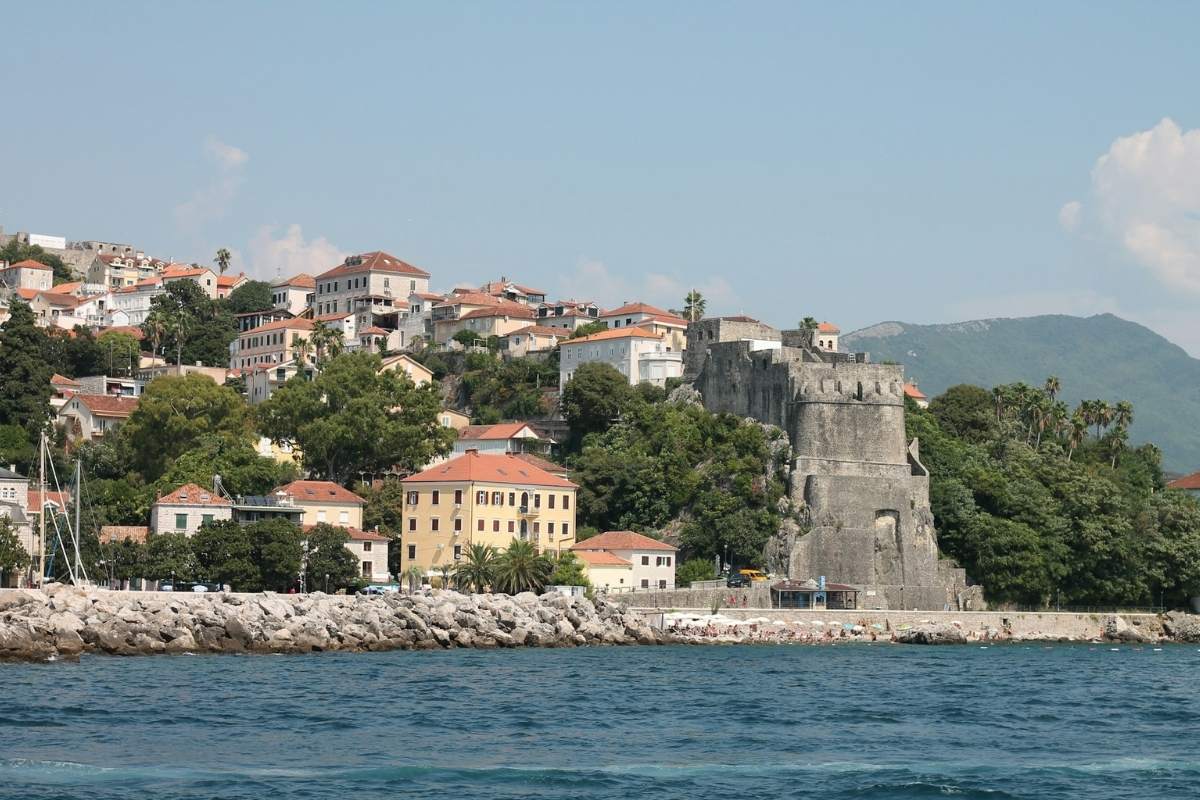
Herceg Novi's stari grad is compact enough to walk in an afternoon and interesting enough to occupy several. The main entrance is through the Sahat Kula — the clock tower, Ottoman-built in the seventeenth century, now the town's primary landmark and the starting point for every walking tour. From there the streets climb steeply, opening into small squares and terraced gardens, passing the Kanli Kula fortress above and the Forte Mare sea fortress below.
The Belavista Square, at the heart of the old town, is the place to sit. The Church of the Archangel Michael anchors one end; café tables spread across the rest. In the evening, when the square lights up and the swallows are flying low, it is one of the better places to be on the entire Adriatic coast.
Kanli Kula Fortress
The name means Bloody Tower in Turkish, and the fortress earned it — built by the Ottomans in the sixteenth century, it served as a prison for most of its working life. Today it hosts open-air concerts and film screenings through the summer, which is a considerable improvement. The views from the upper ramparts across the bay mouth and out to the open Adriatic are worth the climb regardless of what's playing.
Forte Mare
The sea fortress at the water's edge was Venetian, built in the mid-seventeenth century when Venice finally wrestled the town from the Ottomans. It sits directly on the seafront promenade, partly ruined, partly restored, and open to walk through. Stand on its seaward wall and you are looking at the gap between Montenegro and Croatia across open water, with the Adriatic beyond — a perspective that helps you understand why this particular strip of coastline was worth fighting over for seven hundred years.
The Promenade (Šetalište)
Herceg Novi's seafront promenade runs for several kilometres, connecting the old town to the eastern beaches and the suburbs beyond. It is shaded by palms and subtropical plants — the microclimate here supports vegetation you don't normally see this far north on the Adriatic — and lined with cafés, beach access points, and, in the right season, the mimosa trees that give the town its identity. Walk it in the early morning, when the fishermen are still out on the water and the bay is perfectly still.
Swim at Igalo and Meljine
The beaches immediately in front of Herceg Novi are mostly concrete platforms and pebble strips — fine for a swim, not particularly beautiful. The better beaches are a short walk or bus ride east. Igalo, technically a separate town but effectively merged with Herceg Novi, has a long pebble beach and is known across the former Yugoslavia for its therapeutic mud — the Igalo Institute, a Soviet-era health spa, still operates and still draws visitors seeking the mud treatments that were fashionable here in the 1970s. Meljine, further east, is quieter and less developed.
Day Trip into the Bay
From Herceg Novi, the entire Bay of Kotor is accessible. Kotor is forty-five minutes by car or an hour by bus and offers the most complete medieval walled city on the Adriatic coast outside Dubrovnik. Perast, a tiny baroque village midway up the bay, has two island churches in the water just offshore — one natural, one man-made, built over centuries by sailors depositing votive stones — and a quietness that Kotor in summer cannot match. Take a taxi boat from the Perast waterfront out to Our Lady of the Rocks; the boatman will wait while you look around.
Explore Orjen Mountain
Directly behind Herceg Novi, rising to nearly 1900 metres, the Orjen massif is one of the wettest mountains in Europe — which means waterfalls, dense forest, and an almost shocking contrast with the sun-baked coast below. Hiking trails run up from the town through the village of Savina and higher into the Orjen Nature Park. In spring, snow still sits on the upper slopes while people swim in the bay below. The hike is serious; go with a guide or a detailed map.
Where to Stay
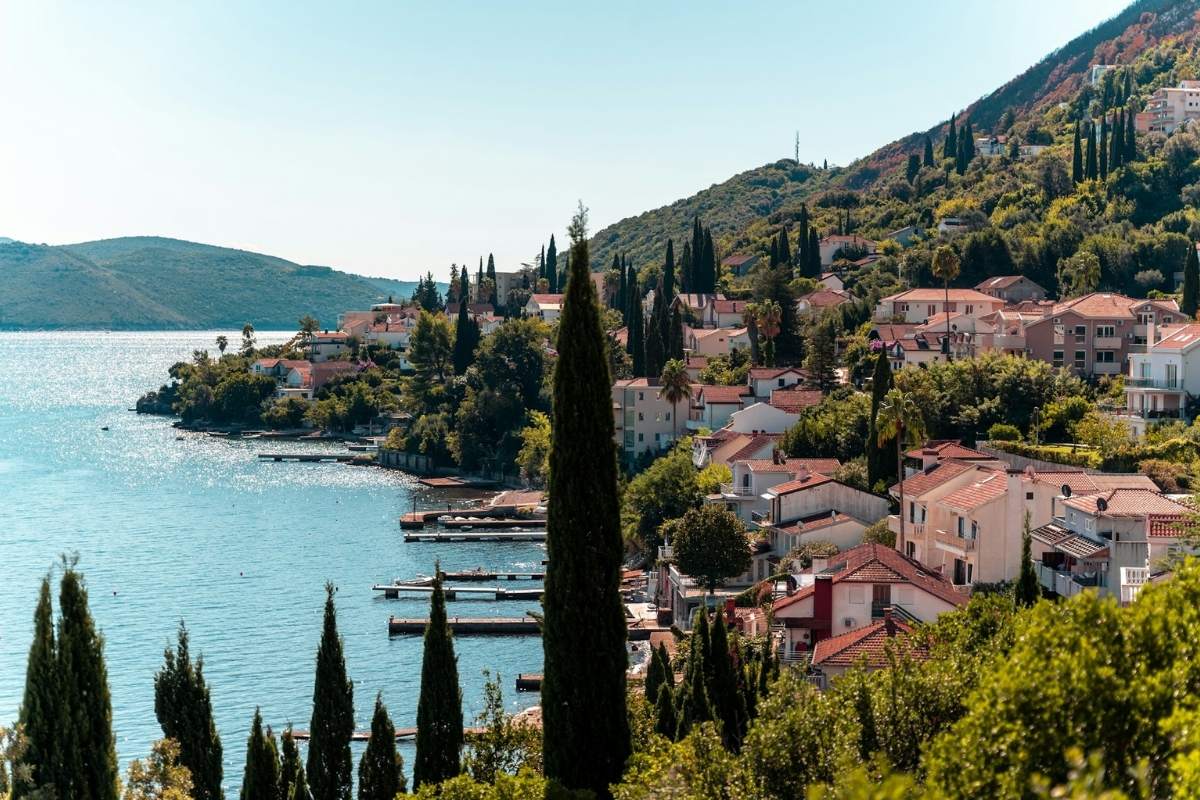
Herceg Novi has not been overbuilt in the way that parts of Budva have. Accommodation ranges from small family-run guesthouses in the old town to modern apartments along the promenade, with a handful of proper hotels at the upper end.
Hotel Perla sits directly on the promenade, with sea-facing rooms and a pool at the waterfront. Reliable, well-run, and positioned well for both the old town and the beach.
Villa Aleksandar is a smaller, family-operated property in the old town — fewer rooms, more character, and the kind of breakfast that makes you reconsider your morning plans. Book early; it fills.
Apartments along the šetalište are plentiful and represent good value. For a stay of more than a few nights, renting an apartment is the sensible choice — you get a kitchen, more space, and a more local rhythm to the days.
Where to Eat
Montenegrin food is Balkan with an Adriatic accent: grilled meats from the mountains, fresh fish from the sea, cheese and bread and olive oil in quantities that require no apology.
Stara Loza occupies a terrace in the old town and does the fish and seafood menu with care. The grilled sea bass is straightforward and correct; the black risotto, made with squid ink, is better than it looks.
Gradska Kafana is the kind of restaurant that has been feeding the town for decades and sees no reason to change. Lamb from the Orjen uplands, roast potatoes, a carafe of house wine. Go for lunch.
Forza Mare at the seafront is the place to spend money if you are going to spend money — refined cooking, good wine list, views across the water at sunset that justify the bill.
For breakfast and coffee, the cafés on Belavista Square operate a pleasant ritual: espresso, burek from the bakery one street over, and no particular reason to move until mid-morning.
Practical Notes
Currency: Montenegro uses the euro despite not being an EU member, which simplifies things considerably.
Language: Montenegrin (mutually intelligible with Serbian, Croatian, and Bosnian). English is spoken in most tourist-facing businesses; Italian is useful along the coast.
Getting around: The old town is entirely walkable. For beaches and day trips, local buses run frequently and cheaply. Taxis are inexpensive by Western European standards; agree on a price before getting in, or ask for the meter.
Visa: Montenegro is not in the EU or Schengen. Most European and North American passport holders can enter without a visa for stays up to 90 days. Check current requirements before travel.
Safety: Herceg Novi is one of the quieter, more relaxed towns on the Adriatic. Petty crime is low. The main hazards are the steep old-town steps after a carafe of local wine.
One Last Thing
There is a particular hour in Herceg Novi — late afternoon, say five o'clock, when the light has begun to soften but the day still has warmth in it — when the bay goes completely flat and you can see the mountains of Croatia reflected in the water on the far side of the channel. The ferry moves across the gap. A fishing boat comes in. Someone at the café table next to yours orders another coffee and opens a newspaper.
Kotor is extraordinary. Dubrovnik is unforgettable. But this — a real town, a working waterfront, a square where the swallows are flying and no one is in a hurry — is something those places, at their busiest, can no longer quite offer.
Herceg Novi has been waiting a long time to be found. It is patient. It will wait a little longer if it has to.


